• Skip to primary navigation
  • Skip to main content
  • Skip to footer
  • MARKETS & PRODUCTS
    • Markets


      Construction

      Cybersecurity

      Fixed Gas & Flame Detection

      General Industry

      Healthcare

      HVAC-R

      Oil & Gas

      Training

      Utilities

      Products


      Combustion Analysis

      Confined Space

      Connected Work

      Corporate

      Fall Protection

      Fixed Gas & Flame Detection

      Gas Analysis

      General

      Head Protection

      Heat Stress

      Leak Detection

      Portable Gas Detection

      Refrigerant Analysis

      Respiratory Protection

      Column
  • SUBSCRIBE

Are You Prepared with Respiratory Protection For Confined Space Applications?

2 Min Read | Sep 22, 2021

Reading Time: 2 minutesHazardous atmospheres are often found within confined spaces. Hazardous conditions can include oxygen deficiency and atmospheric concentrations which make a confined space an immediately dangerous to life and health. Read the full article to learn how to select the right respiratory protection for a confined space environment.

September 22, 2021 by Kimberly Smith

Reading Time: 2 minutes

Hazardous atmospheres are often found within confined spaces. Hazardous conditions can include oxygen deficiency and atmospheric concentrations which make a confined space an immediately dangerous to life and health (IDLH) atmosphere. This makes proper respiratory protection critical to helping keep workers protected in these environments.

How To Select the Right Respiratory Protection

Respiratory protection should be selected once confined space atmospheres have been analyzed and should be provided to all confined space entrants. Recommended confined space respirator types include:

  • SCBA (self-contained breathing apparatus)
  • Dual-purpose SCBA
  • Combination air-line respirators with escape cylinder
  • Air-purifying respirators
  • Escape respirators

Because these devices vary in design, application and protective capability, it is important to first assess worksite contaminant levels as well as stay up-to-date with respiratory protection device limitations to help ensure you choose the right option for your needs  Some respirators may be used for various hazardous environments but if conditions reach IDLH levels or oxygen deficiency, only the highest levels of protection are required.
Confined Space Quiz

Confined space entry can be challenging, and often, can be dangerous. Think you know everything about confined space entry and exit?
Take this quiz to test your confined space I.Q.!

TAKE THE QUIZ

What You Need To Know About SCBA and IDLH Environments

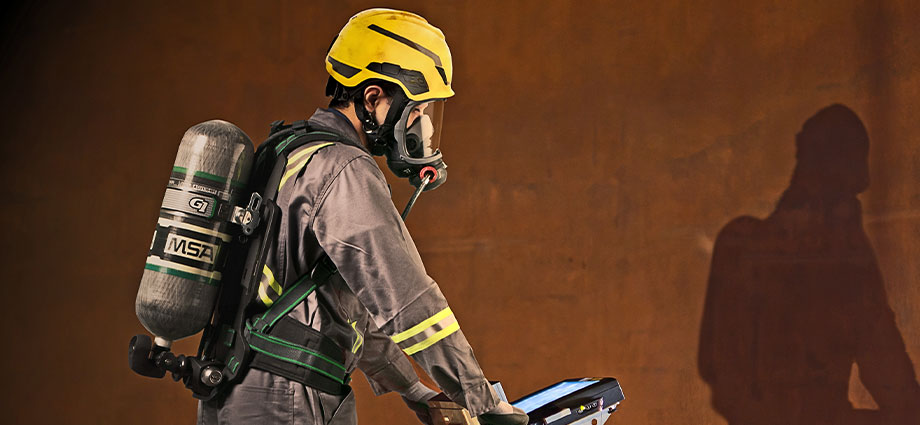
SCBA provide the highest level of respiratory protection for confined space applications. SCBA are equipped with user-worn air cylinders that provide dependable, yet limited air supply without hoses or tethers to impede movement.

Major SCBA components include:

  • air cylinder
  • low-pressure warning device
  • regulator
  • facepiece
  • carrier and harness assembly

SCBA are useful for confined space applications with entrances large enough to accommodate an entrant wearing the apparatus and cylinder; low-profile cylinders are available for tight confined space entrances. Under no circumstances should the entrant enter a confined space that contains a hazardous or potentially hazardous atmosphere unprotected and wait to have SCBA equipment lowered to him or her.

OSHA requires SCBA or combination pressure-demand airline respirators with escape cylinders for entry into IDLH environments. It must be noted that if using an airline respirator with escape cylinder, the user may not use the escape cylinder for entry and must be using the airline as the primary air source, since the cylinder is for escape only.

For both SCBA and combination airline apparatus, Grade D breathing air is regulated down from higher pressures to be delivered to the facepiece in response to breathing demand.  Pressure demand respirators maintain a slight positive pressure to the facepiece at all times, which helps to prevent inward contaminant leakage.

In general, SCBA are available in both low-pressure (either 2216 or 3000 psig) and high-pressure (4500 or 5500 psig) units. For a given cylinder size, high-pressure units have greater storage capacity, enabling longer service life. With high-pressure devices, SCBA users can select from 30-, 45- or 60-minute-rated cylinders. 30-minute-rated cylinders are used with low-pressure SCBA.

MSA’s G1 Industrial SCBA offers NIOSH and NFPA respiratory protection, with unmatched comfort in a lightweight design and chemical-resistant harness with cylinder options so you can match your apparatus to your work. Its Remote Cylinder Connection (G1 iRC) capability allows for use of the same cylinder across all multiple platforms of MSA SCBA, including G1 NFPA SCBA and AirHawk® II SCBA.

Recommended for You

General Industry

Twelve Days of Safety: Navigating the Holidays with Joy and Caution

December 12, 2024
5 Min Read
Construction

Understanding the OSHA Proposed Rule on Heat Stress Prevention: “Heat Injury and Illness Prevention in Outdoor and Indoor Work Settings”

July 30, 2024
4 Min Read
Construction

Responding to Portable Gas Detector Alarms: Benefits of Connected Safety Solutions in Confined Space Applications

August 13, 2024
5 Min Read
Construction

Head Protection Quiz: Test Your Knowledge

August 28, 2024
< 1 Minute Read
Share:

Footer

MSA MISSION: That men and women may work in safety and that they, their families, and their communities may live in health throughout the world.

MSASafety.com

  • Construction
  • General Industry
  • Oil & Gas
  • HVAC-R
  • Utilities
  • Fixed Gas & Flame Detection
  • Fire Service
MSA on Facebook   MSA on X   MSA on Instagram   MSA on LinkedIn   MSA on YouTube  

Contact

  • blog@msasafety.com
  • 1-800-672-2222
  • View All Contact Info
  • Subscribe

Other MSA Blogs

  • Fire Service – The Scene
  • FieldServer – The Safety Connection

© 2024 MSA. All rights reserved.

© 2026 MSA . All rights reserved.

This website uses cookies to improve your experience. We'll assume you're ok with this, but you can opt-out if you wish. Accept Read More
Privacy & Cookies Policy

Privacy Overview

This website uses cookies to improve your experience while you navigate through the website. Out of these, the cookies that are categorized as necessary are stored on your browser as they are essential for the working of basic functionalities of the website. We also use third-party cookies that help us analyze and understand how you use this website. These cookies will be stored in your browser only with your consent. You also have the option to opt-out of these cookies. But opting out of some of these cookies may affect your browsing experience.
Necessary
Always Enabled
Necessary cookies are absolutely essential for the website to function properly. This category only includes cookies that ensures basic functionalities and security features of the website. These cookies do not store any personal information.
Functional
Functional cookies help to perform certain functionalities like sharing the content of the website on social media platforms, collect feedbacks, and other third-party features.
Performance
Performance cookies are used to understand and analyze the key performance indexes of the website which helps in delivering a better user experience for the visitors.
Analytics
Analytical cookies are used to understand how visitors interact with the website. These cookies help provide information on metrics the number of visitors, bounce rate, traffic source, etc.
Advertisement
Advertisement cookies are used to provide visitors with relevant ads and marketing campaigns. These cookies track visitors across websites and collect information to provide customized ads.
Others
Other uncategorized cookies are those that are being analyzed and have not been classified into a category as yet.
SAVE & ACCEPT