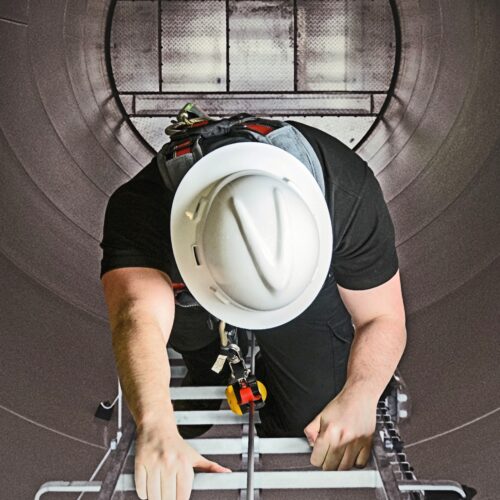
Choosing proper fall protection for your organization often requires several key steps, including understanding the relevant Occupational Safety and Health Administration (OSHA) requirements and American National Standards Institute (ANSI) standards, conducting a hazard assessment to determine the risks associated with your jobsite, and recognizing the breadth of PPE and safety solutions available.
OSHA sets clear guidelines around employer requirements for worker safety when it comes to fall protection.
According to OSHA 29 CFR 1910 for General Industry, employers are required to maintain walking-working surfaces in a safe condition and provide fall protection when employees are exposed to applicable fall hazards. General industry employers must ensure that walking-working surfaces are inspected regularly and as necessary and maintained free of hazards under 29 CFR 1910.221, while 29 CFR 1910.282 establishes the duty to protect workers from falls on elevated surfaces.
Another OSHA standard, 29 CFR 1926 Subpart M outlines fall protection systems criteria and practices for Construction, noting that employers shall provide and install all fall protection systems required by the standard for an employee and shall comply with all other pertinent requirements before that employee begins the work that necessitates the fall protection.3
Steps to Consider When Conducting a Hazard Assessment
Both OSHA and ANSI recognize the importance of identifying worksite hazards.
OSHA encourages employers to identify and evaluate workplace fall hazards and implement measures to help protect employees from those hazards, stating that “Whether conducting a hazard assessment or developing a comprehensive fall protection plan, thinking about fall hazards before the work begins will help the employer to manage fall hazards and focus attention on prevention efforts.”4
ANSI provides more guidance around hazard assessments specifically in ANSI/ASSP Z359.2 Minimum Requirements for a Comprehensive Managed Fall Protection Program, establishing “criteria and requirements for an employer’s fall protection. The program includes policies, responsibilities, training, survey and identification of fall hazards, procedures, controlling fall hazards, rescue planning, program implementation, incident investigation, and evaluating program effectiveness.”5
Key Considerations for a Hazard Assessment May Include:
1. Identify Fall Hazards by Inspecting Elevated Areas and Walking-Working Surfaces
Conduct a thorough assessment of all locations where employees could be exposed to a fall hazard. This includes roofs, mezzanines, elevated platforms, loading docks, ladders, scaffolds, floor openings, skylights, leading edges, and other walking-working surfaces.
Look for potential risks and hazards such as:
- Unprotected sides and edges
- Open floor holes and roof openings
- Fragile surfaces such as skylights
- Access and egress points
- Changes in elevation
- Surface conditions, including slips, trips, and structural deficiencies
- Swing-fall and struck-by hazards
- Environmental conditions such as wind, weather, and lighting
2. Apply the Hierarchy of Controls
Once hazards have been identified, the next step is to determine the most effective means of protection. ANSI/ASSP Z359.2 and common fall protection best practices, including MSA Safety’s approach to site audits and fall protection surveys, emphasize applying a Fall Hazard Hierarchy of Controls:
Hazard Elimination
Whenever possible, remove the need for employees to be exposed to fall hazards.
Examples include relocating equipment to ground level, prefabricating assemblies at ground level before installation, and redesigning work processes to avoid working at height.
Elimination removes the hazard and reduces reliance on worker behavior or equipment performance.
Passive Fall Protection
If elimination is not feasible, passive protection should be considered next. Passive systems help prevent falls without requiring workers to actively connect to equipment.
Examples include guardrail systems, permanent parapet walls, hole covers, safety net systems, and fully guarded work platforms.
Active Fall Protection
When hazards cannot be eliminated or protected through passive systems, active fall protection may be necessary.
The preferred order is:
- Fall Restraint Systems
- Prevent a worker from reaching a fall hazard.
- Often considered a preferred active solution because no fall occurs.
- Fall Arrest Systems
- Allow a fall to occur but stop the descent within the system’s designed limits.
- Typically include a full-body harness, connecting lanyard, life-line anchorage, and energy-absorbing device.
OSHA recognizes personal fall protection systems, including travel restraint and personal fall arrest systems, as acceptable means of protection when passive controls are not feasible.1,2
3. Calculate Fall Clearance and Verify Anchor Strength
Selecting a fall arrest system requires more than simply issuing harnesses and lanyards. A key part of the hazard assessment is determining adequate fall clearance and suitable anchorage.
Fall Clearance Analysis
Employers should calculate the total distance required to safely arrest a fall before the worker contacts a lower level or obstruction. Factors typically include:
- Free-fall distance
- Deceleration distance
- Harness stretch
- D-ring shift
- Worker height
- Safety margin
An improperly calculated clearance may result in workers striking lower levels even if the fall arrest equipment performs as designed.
Anchorage Assessment
Equally important is verification that the anchorage point is capable of supporting anticipated loads.
OSHA requires anchorages used for personal fall arrest systems to be:
- Capable of supporting at least 5,000 pounds per employee attached, or
- Designed, installed, and used as part of a complete fall protection system under the supervision of a Qualified Person while maintaining a safety factor of at least two. 6, 7
ANSI/ASSP Z359.6 further provides engineering standards for the design and qualification of active fall protection systems and anchorages, including travel restraint, fall arrest, positioning, rope descent, and rescue.8
4. Develop Rescue Plans
A documented rescue plan is an important part of a fall protection program. Even when a personal fall arrest system successfully stops a fall, the suspended worker may remain at risk from suspension trauma, shock, or other medical complications.
OSHA requires employers to provide for the prompt rescue of employees in the event of a fall6 or — in construction7 — to assure that employees are able to rescue themselves.
Factors to consider when developing an effective rescue plan include:
- Rescue procedures for each work location
- Rescue equipment requirements
- Rescue personnel responsibilities
- Emergency communication methods
- Worker self-rescue capabilities
- Training and drill frequency
5. Document and Communicate Findings
Documenting the results of the hazard assessment and communicating them to workers can help enhance safety and compliance. Consider documenting findings including:
- Identified fall hazards
- Selected control methods
- Approved anchor locations
- Required PPE
- Inspection requirements
- Rescue procedures
- Training records
- Site-specific work instructions
Written documentation helps demonstrate due diligence, support training efforts, and provide consistency when multiple crews or contractors work on site.
ANSI/ASSP Z359.2 specifically calls for documented fall hazard surveys, written procedures, hazard control methods, and training records as part of an effective managed fall protection program.9
6. Monitor Through Inspections and Periodic Reassessments
Fall hazards can change as facilities age, equipment is modified, work procedures evolve, or environmental conditions shift. Because of this, hazard assessments should not be treated as a one-time activity.
Consider the following as part of a continuous monitoring process:
- Pre-use equipment inspections
- Periodic documented inspections by a Competent Person
- Reassessment after incidents and near-misses
- Evaluation of new tasks or work areas
- Review of rescue readiness with equipment evaluations, plan documentation, and trainings
- Verification of anchor integrity and system performance
Industry standards reinforce this, with OSHA instructing employers to regularly inspect walking-working surfaces and maintain fall protection equipment in safe operating condition1 and ANSI also emphasizing periodic program evaluation, equipment inspections, and continuous improvement to ensure fall protection measures remain effective over time.5
Fall Protection Solutions: PPE and Engineered Systems
Once hazards have been evaluated, you can determine solutions for your jobsite. Fall Protection solutions typically fall into two general categories: PPE and engineered systems.
1. Personal Protective Equipment (PPE)
Fall Protection PPE is used when fall hazards cannot be eliminated and includes components such as harnesses, self-retracting devices (SRDs/PFLs), and anchorage connectors.
Designed to support comfort, compliance, and ease of use, MSA Safety PPE helps workers stay focused on the job, not their PPE. Top solutions include V-SERIES® Harnesses, V-SHOCK® and V-SHOCK EDGE PFLs, and V-TEC® and V-TEC® EDGE PFLs.
2. Engineered Fall Protection Systems
Designed for specific structures, tasks, and environments, engineered fall protection systems often require site evaluation, site-specific engineering, installation, and ongoing support. Like a tailored suit, engineered systems are built around the specific worker, task, structure, and environment, rather than forcing a one-size-fits-all approach onto a complex problem. Examples include horizontal lifelines, fixed ladder systems, and roof walkway systems.
MSA engineered fall protection systems including Vertical Ladder Lifeline Kits and Constant Force® Post Horizontal Lifeline Systems, are built to meet demanding quality and durability requirements and are installed through a network of trusted installers. Another solution that is often included in the engineered fall protection systems category are WinGrip® Vacuum Anchors, which are a configurable vacuum anchor system used in aircraft manufacturing and maintenance, as well as a variety of other environments and industrial applications.
Users should receive training and follow all product instructions, labels, markings, and warnings before using PPE, engineered systems, or related equipment, as required by the manufacturer, applicable standards, regulations, and employer policies.
Enhancing Worker and Worksite Safety
An effective fall protection program begins long before a worker dons a harness. By systematically identifying hazards, applying the hierarchy of controls, validating anchorages and clearance requirements, planning for rescue, documenting decisions, and continuously reassessing risks, employers can help build a fall protection strategy that aligns with OSHA regulations and ANSI best practices while helping enhance worker and worksite safety and compliance.
Explore more fall protection resources and solutions.
Looking for a brief summary of this article? Check it out in USA Today here.
- https://www.osha.gov/laws-regs/regulations/standardnumber/1910/1910.22 ↩︎
- https://www.osha.gov/Laws-regs/regulations/standardnumber/1910/1910.28 ↩︎
- https://www.osha.gov/laws-regs/regulations/standardnumber/1926/1926.502 ↩︎
- https://www.osha.gov/fall-protection/evaluation ↩︎
- https://blog.ansi.org/ansi/ansi-assp-z359-2-2023-fall-protection-program/ ↩︎
- 1910.140 – Personal fall protection systems. | Occupational Safety and Health Administration ↩︎
- https://www.osha.gov/laws-regs/regulations/standardnumber/1926/1926.502 ↩︎
- https://webstore.ansi.org/standards/asse/ansiasspz3592026 ↩︎
- https://www.assp.org/news-and-articles/q-a-what-the-updated-z359.2-standard-means-for-managed-fall-protection-systems ↩︎
Recommended for You