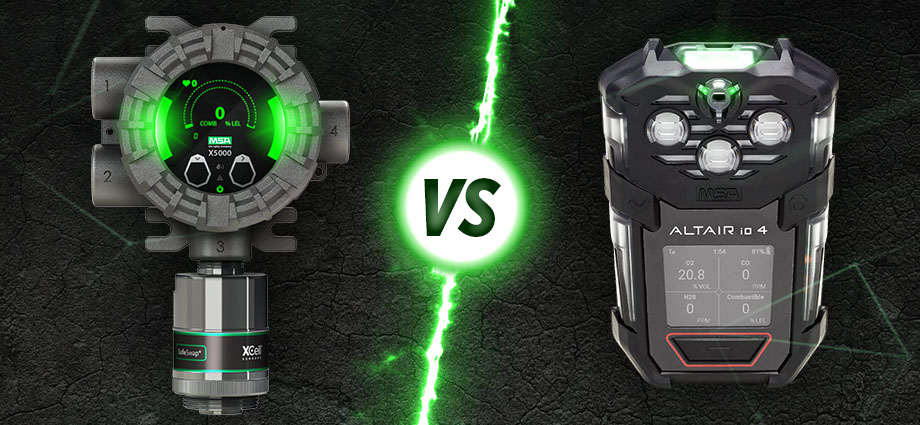
Protecting people, equipment, and facilities from combustible and toxic gases is a critical responsibility in many industrial environments. Fixed and portable gas detectors are important safety tools designed with a range of sensing technologies to support different applications. For safety managers and instrumentation engineers, the challenge is determining which type of detector provides the appropriate level of protection for a given situation.
Few organizations can justify installing fixed gas detection in every manhole or confined space. Likewise, it may not be practical or cost-effective to station personnel with portable detectors throughout an entire facility. The decision often falls somewhere between these extremes. Understanding when to rely on fixed detection and when portable instruments are more appropriate is key to building a balanced gas safety program.
This article outlines the strengths, limitations, and typical applications of fixed and portable gas detectors, as well as the sensing technologies commonly used in both.
Gas Detection Sensing Technologies
Gas detection relies on a variety of sensing technologies; although fixed systems can accommodate a broader range of these technologies, many sensor types are used in both fixed and portable applications.
Catalytic Bead Sensors
Catalytic bead technology has long been used for detecting combustible gases and vapors. These sensors consist of two ceramic beads formed on platinum filaments, one active and one inert reference. Electrical current heats the beads to a temperature at which flammable gas can oxidize on the active bead only. The resulting change in electrical resistance is measured and converted into a gas concentration reading.
Catalytic bead sensors are commonly used in both fixed and portable detectors. Because they rely on oxidation, they may not perform as reliably in oxygen-deficient atmospheres.
Electrochemical Sensors
Electrochemical sensors are among the most widely used gas detection technologies due to their accuracy, fast response, and relatively low cost. These sensors generate an electrical signal when exposed to a specific target gas.
Many electrochemical cells have a finite service life, commonly ranging from two to three years, depending on gas type, exposure, and environmental conditions. Some modern sensor designs offer extended service life of up to 5–7 years, depending on application and conditions. Example: MSA XCell® Sensors are designed for extended service life in both portable and fixed applications.
Interfering gases can affect sensor response, making it important to understand cross-sensitivity characteristics. Electrochemical sensors are available for most encountered toxic gases, as well as oxygen, and are widely used in both portable and fixed systems.
Infrared Sensors
Infrared gas detection uses specific wavelengths of infrared light that are absorbed by target gas molecules. As gas passes through the optical path, it reduces the intensity of the infrared beam in proportion to the gas concentration.
Due to higher power requirements, infrared sensors are more commonly used in fixed gas detection systems than in portable instruments. They are also well suited for oxygen-deficient atmospheres and applications where resistance to sensor poisoning is important.
Ultrasonic Gas Leak Detection
Ultrasonic detectors identify pressurized gas leaks by detecting the high-frequency sound generated by escaping gas. Unlike concentration-based sensors, ultrasonic detectors do not rely on gas accumulation.
This technology is typically used in fixed installations, particularly in outdoor or well-ventilated areas where gas disperses rapidly. Performance is generally unaffected by wind direction, gas type, or oxygen levels.
The Basics of Fixed Gas Detection Systems

A fixed gas detection system may consist of a single detector or hundreds of detectors hardwired to a wall-mounted controller or integrated into a programmable logic controller (PLC) or distributed control system (DCS).
These systems typically use a dedicated power supply, field wiring, and controllers designed to withstand electrical noise, voltage disturbances, and environmental exposure. Detectors transmit status and alarm signals to a central controller or control room, enabling operators to monitor system conditions.
Fixed systems can be configured to activate other safety functions, such as audible and visual alarms, ventilation systems, process shutdowns, or fire suppression systems.
Key Design and Installation Considerations for Fixed Systems
Fixed gas detection systems should be designed, installed, and commissioned by qualified professionals. Smart, microprocessor-based detectors with digital communications protocols such as HART or Modbus are commonly used to simplify integration with PLCs and DCS platforms.
Detector placement is one of the most critical aspects of system performance. While there are no universal placement rules applicable to all facilities, gas mapping or gas dispersion analysis are often used to guide detector location. Common location considerations include:
- Installing sensors near expected leak sources or where gas is likely to accumulate. Methane tends to rise, hydrogen sulfide tends to sink, and carbon monoxide mixes readily with air.
- Selecting locations that allow safe access for inspection, bump testing, and calibration.
- Avoiding areas near radio transmitters or sources of electromagnetic interference.
- Mounting detectors in ways that minimize exposure to standing water, dust buildup, or debris that could obstruct the sensor.
Fixed Systems in Hazardous Locations
Fixed gas detectors intended for hazardous locations are commonly certified as either Intrinsically Safe or Explosion-Proof systems. Applicable hazardous area classifications and approval requirements vary by country and standard system.
Intrinsically Safe systems limit electrical and thermal energy so that ignition is not possible under normal or fault conditions. When properly designed with appropriate barriers or isolators, these systems may allow certain maintenance activities without hot work permits.
Explosion-Proof (or “Flameproof,” as it’s known under IEC/ATEX) systems house electronics in heavy-duty enclosures designed to contain an internal ignition and prevent flame propagation to the surrounding atmosphere. These systems are typically used in very harsh environments and may require explosion-proof conduit/sealing or cable entry practices, depending on the standard.
When is a Fixed Gas Detection System Recommended?
Fixed gas detection systems are typically used in applications where continuous monitoring of known gases is desired. They can provide ongoing surveillance, automatic alarming, safety system activation, and data logging for operational review and incident investigation.
Operators can oversee many detection points from a centralized location, including areas that may be remote or difficult to access routinely. Maintenance requirements are generally limited to periodic inspection, calibration at manufacturer-recommended intervals, and sensor replacement based on service life. Additionally, many industrial facilities work 24/7/365. The FieldServer gateways provide flexibility to stay connected to fixed gas and flame detectors when away from the facility or to keep watch on unmanned facilities.
Portable Gas Detectors Overview
Portable gas detectors are available in a wide variety of configurations and are designed to provide mobility and flexibility. Many modern portable detectors are microprocessor-based and include onboard data logging as well as cloud-hosted data capabilities.
Most portable gas monitors detect between one and four gases, with more advanced models capable of detecting up to six gases using electrochemical sensors, along with a combustible gas sensor for LEL monitoring. Common gas combinations include oxygen, hydrogen sulfide, carbon monoxide, and combustible gases. Sensor service life varies by type, exposure, and operating conditions.
Many portable detectors support interchangeable or smart sensor technology, allowing users to adapt instrumentation to changing gas monitoring needs. Internal or external sampling pumps are commonly used for confined space monitoring.
Key Considerations When Selecting Portable Gas Detectors
Portable gas detectors are subject to frequent handling and exposure to harsh conditions, making durability an important consideration. Other commonly evaluated features include:
- Ingress protection ratings appropriate for wet or dusty environments
- Displays that are large, backlit, and easily readable under field conditions
- Audible alarms that are clearly perceptible in noisy work environments
- Highly visible visual alarms that can be seen from multiple angles
- Smart sensor design for ease of sensor replacement and configuration
- User-friendly calibration and data download software
- Non-volatile memory to retain logged data during power loss
- Rechargeable battery technology suitable for repeated field use
- Availability of multilingual interfaces, depending on workforce needs
Portable detector service life commonly ranges from one to several years, depending on usage intensity, environmental exposure, and maintenance practices.
When Are Portable Gas Detectors Considered Best Practice?
The primary advantage of portable gas detectors is flexibility and personal safety – it can move with the user and detect gas levels in the breathing zone, which is especially important in potentially hazardous areas. They can be deployed where monitoring is needed and removed as conditions change.
Portable instruments are especially useful for confined space entry, maintenance activities, leak investigation, and other temporary operations. Using sampling pumps and tubing, workers can test confined spaces before entry while avoiding direct exposure.
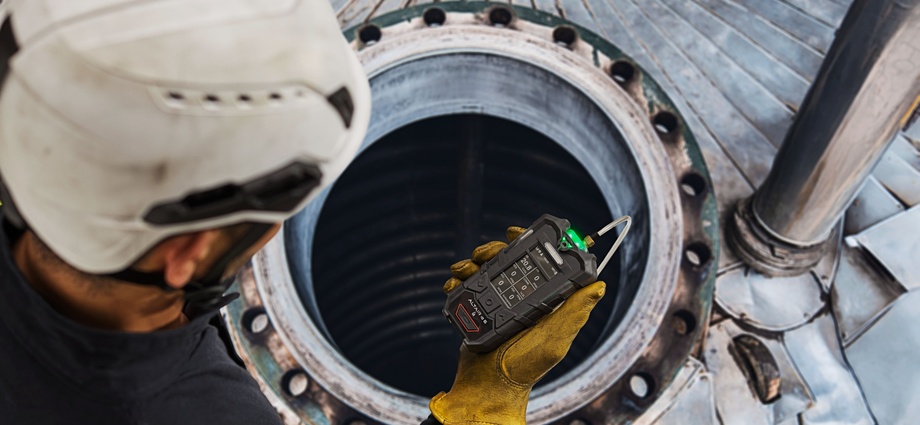
Connected solutions further enhance the effectiveness of portable monitoring. Platforms such as MSA’s Connected Worker integrate portable gas detectors with cloud-based software and real-time connectivity, enabling safety teams to monitor worker conditions, receive alerts, and respond more quickly to potential risks. These systems also provide valuable data insights that support compliance efforts and ongoing safety improvements.
Because portable detectors are typically worn or carried by workers, they are intended to supplement, not replace, fixed systems which provide continuous, unattended monitoring.
Comparing Fixed and Portable Gas Detectors
Portable gas detectors generally have a lower initial cost and require minimal infrastructure. They offer flexibility and mobility but rely on proper use by personnel and do not provide continuous area monitoring.
Fixed gas detection systems provide continuous protection, centralized monitoring, and the ability to trigger automated safety responses across larger areas or entire facilities. These systems are typically treated as capital investments rather than personal protective equipment (PPE).
While cost comparisons are often considered, fixed and portable detectors serve fundamentally different safety functions and are not interchangeable solely based on price.
Fixed vs. Portable Gas Detectors: Which Is Right for Your Facility?
Where gas hazards are known and continuous monitoring is desired, fixed gas detection systems are typically the most appropriate solution. When monitoring needs are intermittent, change frequently, or involve confined spaces, portable gas detectors are often the better choice.
Both fixed and portable gas detection systems play essential and complementary roles in protecting personnel and facilities. Fixed systems provide continuous area monitoring, while portable detectors support personal safety and confined space entry. The selection, placement, and use of both system types should be carried out in accordance with applicable regulations, standards, and industry best practices.
Regulatory Disclaimer
This article is intended for general informational and educational purposes only. It does not constitute legal, regulatory, engineering, or safety advice. Gas detection system selection, design, installation, and maintenance must comply with applicable local, state, federal, and industry regulations, including OSHA, NFPA, IEC, ATEX, or other governing standards as applicable. Requirements may vary by jurisdiction and application. Always consult qualified safety professionals, equipment manufacturers, and applicable codes before implementing or modifying any gas detection solution.
Recommended for You