Modern facilities are getting bigger and taller. Warehouses, aircraft hangars, manufacturing plants, and energy facilities all benefit from open, high-ceiling designs.
But when it comes to fixed gas detection, those same design choices can introduce blind spots if they’re not carefully addressed.
One of the most common and often underestimated factors is gas layering, also known as gas stratification.
What Is Gas Layering in High-Ceiling Spaces?
Gas layering occurs when gases concentrate at specific heights instead of mixing evenly throughout a space.
In smaller or well-mixed environments, gases may disperse more uniformly. In high-ceiling environments, that assumption doesn’t always hold, especially when airflow and temperature differences limit vertical mixing.
Understanding gas layering is a key consideration when designing gas detection systems for large or tall facilities.
Why Gases Don’t Always Mix as Expected
Gas Density and Stratification
Gas density plays a major role in where gases accumulate.
- Lighter gases like methane and hydrogen typically rise
- Heavier gases such as propane, butane, and solvent vapors may settle near the floor
In high-ceiling environments, these tendencies can persist longer; particularly when vertical airflow is limited.
Temperature Gradients and Thermal Layers
Temperature differences can further influence gas movement. Warm air rises, while cooler air remains lower. In large facilities, this can create stable thermal layers that reduce mixing.
Common contributors include:
- Process heat
- Sunlight through roofing
- Large equipment or localized heat sources
Under these conditions, gases may remain concentrated at certain elevations rather than dispersing.
Limited Vertical Airflow
Many HVAC systems are designed for occupant comfort and not full air mixing. As a result:
- Air movement may be concentrated near occupied zones
- Air near the ceiling may remain relatively stagnant
This can allow gases to remain at the elevations where they naturally migrate.
Release Conditions and Accumulation
How gas is released also affects behavior.
- Pressurized releases may disperse initially
- As momentum decreases, gases may separate based on density
- Slow leaks can allow gas to accumulate gradually over time
In high-ceiling spaces, this can lead to concentration at elevations that are not immediately obvious.
Why High-Ceiling Environments Require a Different Approach
Compared to smaller spaces, high-ceiling environments may experience:
- Greater vertical separation of gases
- More stable thermal layers
- Gas accumulation outside typical monitoring zones
This means hazardous conditions can develop in areas that may not be detected with standard sensor placement strategies.
Gas Detector Placement in High-Ceiling Spaces
A common approach is to install gas detectors at a single height, often around breathing level. While appropriate in some applications, this may not provide adequate coverage in high-ceiling environments.
In many applications, gas detector placement should reflect where gas is most likely to accumulate. Depending on the environment, this may include:
- Ceiling-level placement for lighter-than-air gases
- Low-level placement for heavier-than-air gases
- Multiple sensor elevations to account for varying conditions
Airflow patterns, temperature gradients, and potential leak sources should also be evaluated as part of the overall system design.
Addressing Maintenance and Accessibility Challenges
Optimizing sensor placement often means installing detectors in hard-to-reach locations. Routine calibration and maintenance in these environments may require:
- Lifts or scaffolding
- Additional safety procedures
- Operational disruptions
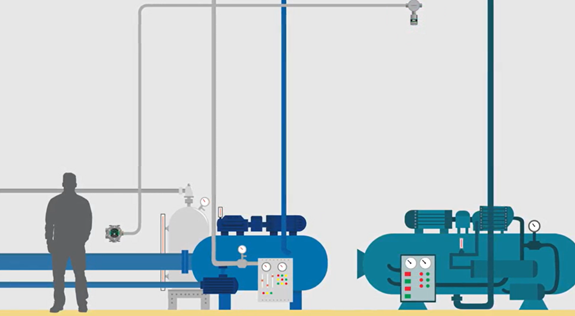
To help address this, some facilities use remote calibration or mounting solutions. For example, the CalGard® Remote Calibration Adapter can help enable calibration from a more accessible location while allowing sensors to remain positioned based on expected gas behavior.
Designing for Long-Term Gas Detection Performance
Fixed gas detection systems require ongoing calibration and functional testing. If access is difficult, maintenance may become more time-consuming or delayed, potentially impacting system effectiveness over time. Designing with accessibility in mind can help support:
- Safer maintenance procedures
- Reduced downtime and labor requirements
- More consistent system upkeep
Key Takeaways for High-Ceiling Gas Detection Design
- Gas layering can impact detection coverage in large or tall spaces
- Temperature and airflow conditions may reinforce stratification
- Single-height sensor placement may not be sufficient in all applications
- Sensor placement should consider gas properties and site-specific conditions
- Remote calibration solutions can support safer and more efficient maintenance
Final Thought
High-ceiling spaces don’t just change the size of a facility; they can change how gases behave within it. Detection strategies that account for gas layering, airflow, and temperature effects are more likely to provide effective coverage over time. Gas detection system design should always be based on site-specific conditions and aligned with applicable codes, standards, and risk assessments.
Learn More About Gas Detection Best Practices
Designing for high-ceiling environments is just one piece of a broader gas detection strategy.
For a deeper look at gas behavior, sensor technologies, and application considerations, explore the MSA Fixed Gas & Flame Detection Handbook.
GET YOUR HANDBOOKIf you have questions about your specific application, MSA’s technical experts are available to support your evaluation process, including mapping services that can help guide sensor placement based on real-world conditions.
Frequently Asked Questions About High-Ceiling Gas Detection
What is gas layering in gas detection?
Gas layering (or stratification) occurs when gases concentrate at specific heights instead of mixing evenly. This is common in high-ceiling spaces where airflow and temperature differences limit vertical mixing.
Where should fixed gas detectors be placed in high-ceiling spaces?
Gas detectors should be placed where gas is most likely to accumulate. This may include ceiling-level placement for lighter gases, low-level placement for heavier gases, or multiple elevations depending on site conditions.
Why doesn’t gas mix evenly in large spaces?
In large or tall environments, limited vertical airflow and temperature gradients can prevent full air mixing. This allows gases to remain concentrated at certain elevations.
Do high ceilings affect gas detection system performance?
High ceilings can impact detection coverage if sensor placement does not account for gas behavior, airflow, and temperature conditions within the space.
How do you maintain permanent gas detectors installed at height?
Remote calibration or mounting solutions can help improve accessibility by allowing maintenance from a safer, more convenient location.
Recommended for You