Across wastewater treatment plants, mechanical rooms, and light industrial facilities, safety and operations leaders are taking a closer look at how their gas monitoring systems support uptime, maintenance efficiency, and integrate with existing site infrastructure.
The conversation has shifted from:
“Do we have gas detection installed?” to “Is our gas detection system reliable, visible, and manageable over the long term?”
The Operational Impact of Aging Gas Monitoring Systems
Many facilities continue operating legacy fixed gas monitors that were installed years — or even decades — ago. While still functional, these systems may:
- Require frequent calibration
- Offer limited diagnostic visibility
- Increase technician labor time
- Create challenges during integration with site control systems
- Reduce confidence in alarm capability
Over time, these factors can add operational and maintenance complexity.
Modern fixed gas detection systems are increasingly evaluated not only for hazard detection capability, but also for how they support ongoing maintenance workflows and compliance programs.
What Facilities Now Expect from Fixed Gas Detection
When reviewing or upgrading an industrial gas monitoring system, decision-makers typically look for solutions that support:
- Continuous Area Monitoring
- Provide ongoing detection of combustible gases, toxic gases, or oxygen deficiency in occupied and unoccupied spaces.
- Clear Visual Status Indication
- Offer integrated displays, visible indicators, and audible alarms to support quick inspection and alarm awareness.
- Maintenance Efficiency
- Incorporate sensor technologies designed to support stable performance and extended calibration intervals, depending on environmental conditions and facility policies.
- Simplified Service Access
- Allow configuration and maintenance activities to be performed efficiently, potentially reducing disruption to operations.
A Practical Example: Modern Fixed Monitoring for Light Industrial Applications
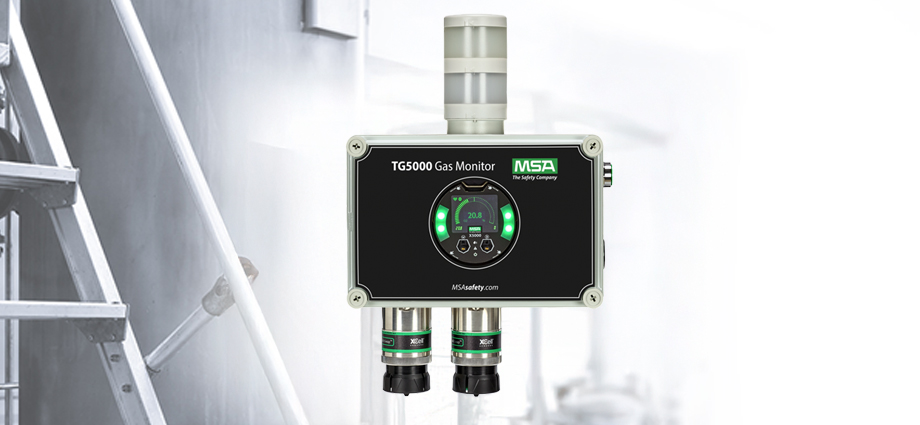
To illustrate how modern systems address these expectations, consider a current generation solution such as the TG5000 Gas Monitoring System.
The TG5000 is a self-contained fixed gas monitor intended for light industrial and commercial applications. Depending on configuration, it can be used to detect combustible gases, toxic gases, or oxygen levels.
Features that align with evolving facility expectations include:
- Integrated display with LED status indicators
- Bluetooth capability to support configuration and maintenance activities
- Sensor technologies designed to help support longer calibration intervals in appropriate applications
- All-in-one design with horn (95 dB) and optional strobe for alarm functions
It is commonly considered for spaces such as:
- Wastewater treatment areas
- Light manufacturing facilities
- Boiler and mechanical rooms
- Commercial and public buildings
Rather than adding system complexity, solutions in this category are designed to support straightforward installation and long-term manageability.
Fixed vs. Portable Gas Detection: A Complementary Strategy
Portable gas detectors help protect individual workers during task-based activities, but they only measure conditions where they are worn and only while in use. Fixed systems complement this by providing continuous area monitoring, including during off-hours or in spaces that may not always be occupied.
Because they are installed in the environment, fixed gas monitors can offer area-wide visual and audible indicators and can support risk mitigation and ventilation strategies depending on facility policies.
Many facilities adopt a layered approach that combines both technologies to support broader safety objectives and documentation processes.
Indicators That It May Be Time to Evaluate an Upgrade
Facilities may consider reviewing their current fixed gas monitoring system if they observe:
- Increasing maintenance time, costs, or calibration demands
- Difficulty sourcing replacement components
- Limited diagnostic visibility
- Interoperability inefficiencies
- Reduced confidence in alarm reliability
Gas detection technology has advanced significantly in recent years. Modern systems are often designed with serviceability, visibility, and long-term operational efficiency in mind.
The Broader Trend: Safety Systems That Support Operations
Industrial safety strategies continue to evolve. Today’s leaders are looking beyond basic hazard detection and asking how systems:
- Support predictable maintenance schedules
- Enhance visibility into potential gas hazards
- Assist with documentation and inspection processes
- Integrate more smoothly into facility operations and systems
Fixed gas detection is increasingly viewed as part of overall operational resilience — not solely as a compliance requirement.
Evaluating Your Fixed Gas Detection Strategy
If your facility is reviewing existing gas monitoring equipment or planning upgrades, it may be helpful to assess:
- How much time is currently spent on calibration and service?
- Is system status clearly visible during routine inspections?
- Can maintenance activities be performed efficiently?
- Does the system align with internal safety and documentation policies?
Modern fixed gas monitors, including options such as the TG5000, are designed to support these operational considerations while maintaining dependable area monitoring.
For facilities exploring modernization, application-specific evaluation and system selection guidance can help ensure the chosen solution aligns with environmental conditions, safety objectives, and regulatory requirements. A technology review can help determine whether your facility’s current system meets today’s operational expectations. If your facility is considering an update or would benefit from a tailored assessment, our team is available to discuss application-specific needs and help support your evaluation process.
Recommended for You