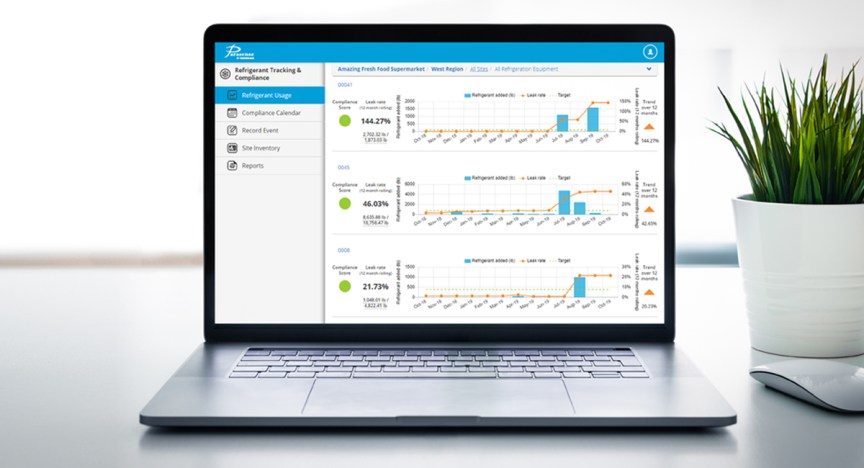
MSA’s Parasense refrigerant management platform has analyzed nearly three billion samples allowing us to identify the most common refrigerant leak events. It’s not only about saving money; federal & individual state compliance is a must, especially with compliance becoming even stricter due to the EPA AIM Act. To help drive down refrigerant emissions, help lower refrigerant costs, and help increase the profitability of food retailers nationwide, we have identified five refrigerant leak events to watch out for.
Data-driven Leak Reduction for Food Retailers
Swiftly detecting, notifying, and fixing refrigerant leaks is an important objective for any industry where cooling and refrigeration are critical. The benefits of reducing refrigerant leaks include ensuring product quality, enhancing employee and customer safety, reducing operating costs, and improving equipment performance.
But before we dive into the five refrigerant leak events, let’s cover some basics about why refrigerant leaks occur, how they can be detected as early as possible, and how a connected data-driven system can streamline and empower your refrigerant management program.
WHY DO REFRIGERANT LEAKS OCCUR?
Refrigerant leaks are prevalent where piping and refrigeration equipment are exposed to changes in temperature, pressure, and vibration. In a supermarket, the primary areas for refrigerant leaks are the refrigeration racks, walk-in coolers and freezers, and display cases on the sales floor. Leaks can also appear elsewhere in the system, such as service runs where vibrational changes occur.
Leaks do come and go, and spending the time to find them can be a time-consuming and tedious activity for service engineers.
WHY SHOULD SUPERMARKETS DETECT LEAKS EARLY?
It’s often said that leaks only get bigger if ignored, so the sooner you know there’s a leak, the sooner you can fix it. After all, even a pinhole-sized leak, if ignored, can eventually lead to a catastrophic leak event that may result in product loss.
This means your leak detection equipment should be capable of reliably detecting even the smallest of leaks. Industry-leading fixed leak detection equipment, such as the MSA Bacharach® Multi-Zone Gas Detector, can detect leaks as low as 1 ppm for halogenated gases. With such a low ppm detection threshold, a leak can be spotted early and, therefore, can be fixed before it causes a bigger problem.
How Can IoT Connected Devices Enable Faster Leak Detection?
So, you’ve got a refrigerant leak and the facility’s leak detection equipment has triggered an alert. How do you know if this is happening in a far-off room or originating from a remote appliance? What if the leak comes and goes or airflow near the leak regularly dilutes the refrigerant to create changing conditions?
A connected system can notify you of any leaks immediately through email, SMS, or even a phone call if the system is fully managed. This enables you to take decisive action as soon as possible. In addition, by having a data-driven system that timestamps and records each time a leak is detected, a history can be built up and reviewed over a longer period. This can help you identify problem areas that need further maintenance.
Connected systems can also help refrigeration contractors locate the leak itself. Whether in a specific room or originating from a specific appliance, a connected system may provide useful data that can help quickly identify the problem area.
How Can Refrigerant Leak Levels Be Categorized?
As stated at the start of this article, our analysis of refrigerant leaks involved nearly three billion leak events across all refrigerant classifications—HFCs, Ammonia (NH3), Carbon Dioxide (CO2), and hydrocarbons (HCs). Regardless of refrigerant classification, many leaks demonstrated the same type of event characteristics and patterns.
To better organize these events, we categorize the levels into Alert, Alarm, and Critical, depending on the response preferred by our customers.
Alert Level
The Alert level is the early warning indication of a pending refrigerant leak. With HFCs, we are looking at the 10 to 40 ppm range. At this level, leaks are more difficult to find but identification and rectification can mitigate any additional refrigerant loss and help lower the potential for negative impacts on the system performance.
Perseverance by maintenance engineers is encouraged. Taking a proactive approach to hunting for refrigerant leaks under the 50 ppm threshold can help a supermarket’s bottom line by prolonging the timeline of the system needing a recharge.
Alarm Level
The Alarm level is usually the call for an engineer to examine the system. When looking at HFCs, this level would be when the detector registers refrigerant gas in the 80 to 100 ppm range. The leak is still small at this level but should be easier for an engineer to find, identify, and fix.
Rectifying a leak quickly at this level should keep refrigerant loss to a minimum without negative impacts on system performance.
Critical Level
The Critical level usually indicates a sizeable leak on-site. This range may be established in accordance with certain compliance requirements or customer safety protocols. Reaching a Critical level may also trigger local beacon sounders to help alert personnel to a high refrigerant emission and may engage exhaust fans.
Most importantly, immediate action by service engineers is recommended at this level.
TOP FIVE most common COMMERCIAL REFRIGERATION REFRIGERANT LEAK events
The following are the five most common refrigerant leak events:
The Over-nighter Refrigerant Leak Pattern

The Over-nighter event is characterized by a very small leak that is difficult to detect during the daytime due to increased air movement and diffusion.
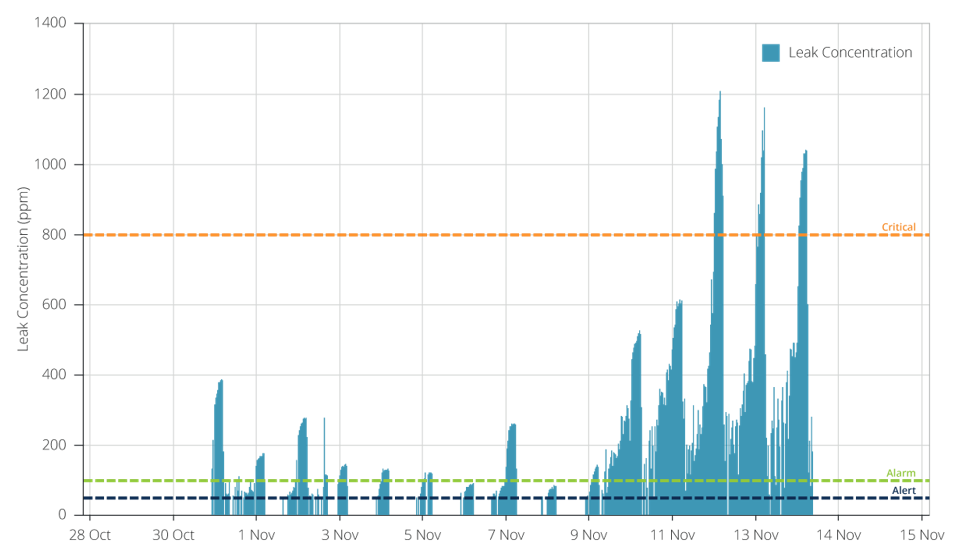
The Over-nighter leak pattern shows the development of the refrigerant building up from the evening onward, followed by a drop when the refrigerant dissipates in the morning once the store is opened and goods are moved in and out. Areas where this type of leak pattern is prevalent include a store’s walk-in coolers and freezers. During the night when the supermarket is closed and the walk-in is unused and doors are kept closed, the leak slowly builds until it exceeds the alarm threshold. As the walk-in is opened during business hours, the refrigerant dissipates, and the measured concentration may fall below the alarm threshold.
This graph shows how the leak concentration can increase over time. If the leak had been detected and fixed early, there would have been less refrigerant loss.
The Volcano Refrigerant Leak Pattern

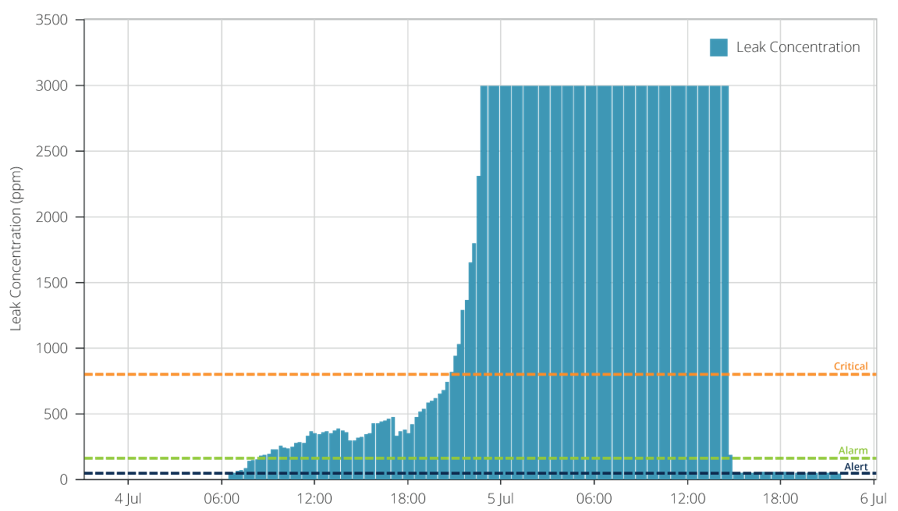
The Volcano is more like a classical leak event pattern which builds up over time and, if not fixed, can cause a major eruption in refrigerant.
Refrigeration racks, walk-in coolers and freezers, and display cases can each potentially demonstrate this type of leak pattern. Installation of a leak detection system across all critical assets can be a key to detecting this type of leak.
In the case below, the opportunity to detect and fix the leak was extremely short before the major leak occurred. Had the leak been detected and responded to as soon as the measured refrigerant concentrations exceeded the alert or alarm threshold, the catastrophic leak may have been avoided and the system downtime could have been significantly reduced.
The Defroster Refrigerant Leak Pattern

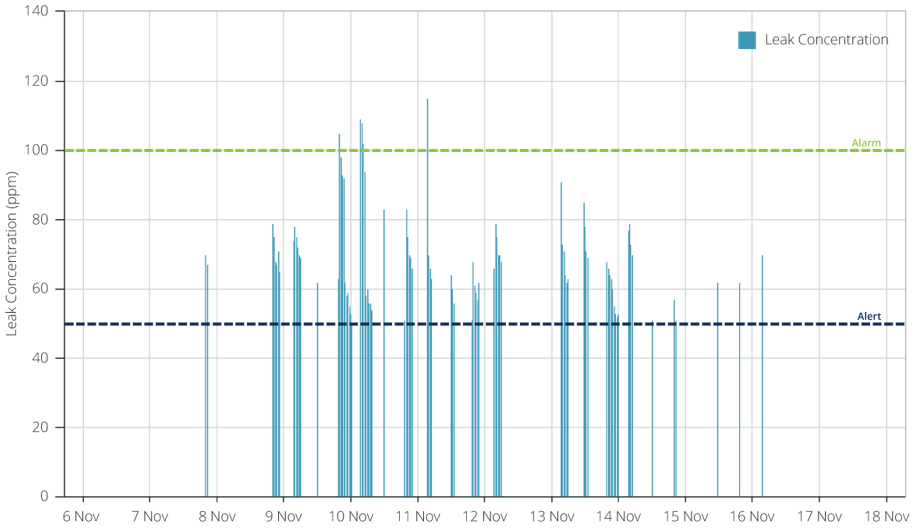
Found mainly inside a cold storage room, walk-in box, or display cabinet, the Defroster leak pattern can be spotted when the coil is on defrost.
In a food retail application, most assets have a defrost schedule built-in to help avoid any build-up of ice on the coil. The defrost cycle is typically set for six to eight hours, during which there’s a rapid change in temperature and pressure, especially on the evaporator coil, which can contribute to leaks. When the evaporator coil is in refrigeration mode and cold, the leak may be sealed; but when the coil is heated during the defrost cycle, the leak can be exposed. This is attributed to expansion in the pipework and thus, the leak can appear and disappear in sync with the defrost cycle. If this leak pattern is not detected and identified, an engineer may lack proper insight to diagnose the issue correctly, as there would be no refrigerant gas present when the equipment is in refrigeration mode. It is important to effectively utilize maintenance assets to help reduce the need for repeat visits.
The Under-cover Refrigerant Leak Pattern

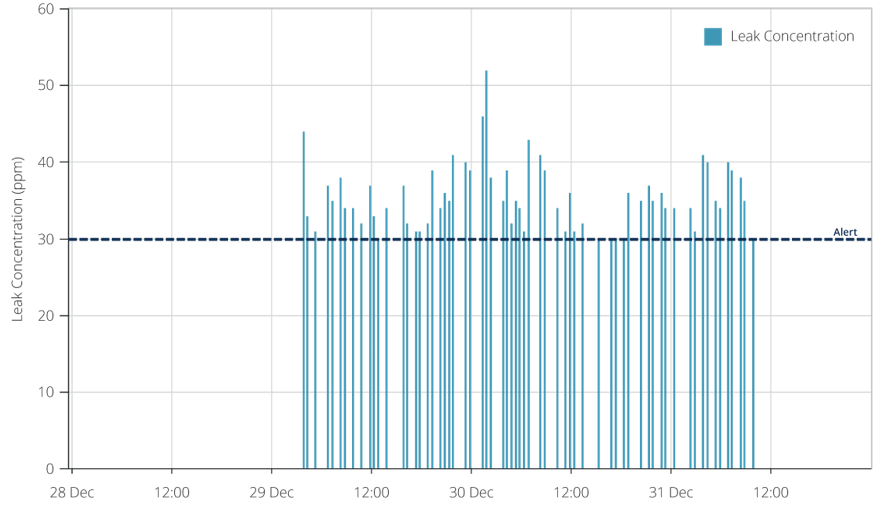
This type of leak is difficult to find using standard detection methods and may require considerable effort and patience.
Perseverance by the refrigeration engineer and appropriate utilization of the available data can aid in detecting and identifying the location of the leak.
The illustration below shows a small leak of just over 30 ppm. In the case, the leak did not exceed the applicable threshold and thus does not generate an alarm. At this level, the leak may not affect the equipment’s performance or temperature. However, over time, it results in a considerable amount of refrigerant gas loss.
Using this data, the maintenance team can triangulate the leak location, which is slightly outside the area covered by the refrigerant leak detection system.
The Repeater Refrigerant Leak Pattern

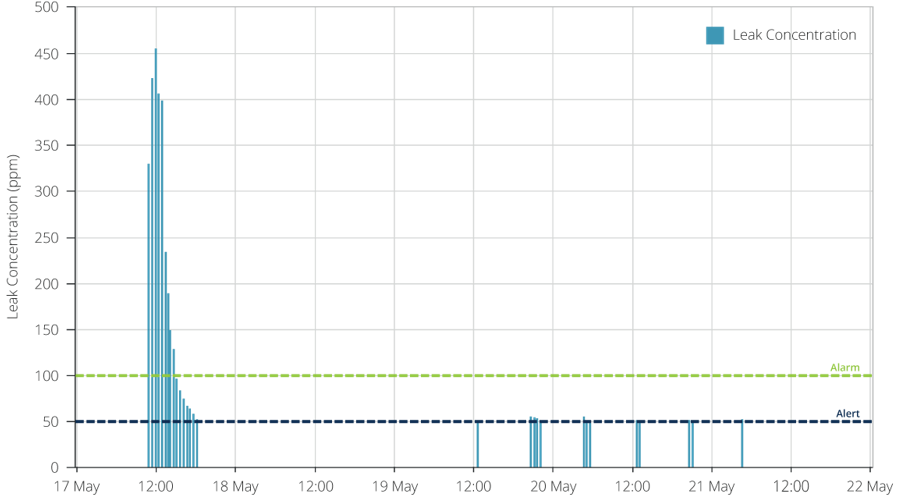
The Repeater leak event pattern is characterized by a leak event that has been addressed but is followed by a smaller leak.
In this case, having the onsite leak detection equipment permanently monitoring the asset helps prevent further refrigerant loss from the system. Again, food retailers prefer that refrigerant leaks are resolved on the first visit by a maintenance contractor. Properly addressing refrigerant leaks the first time helps contain refrigerant gas and maintain the performance of critical equipment while also eliminating the need for repeat visits.
RESPOND TO THESE LEAKS PROPERLY WITH COMPREHENSIVE REFRIGERANT MANAGEMENT
These five most common leak event patterns come from our extensive refrigerant leak analysis of over 2.8 billion samples. Ultimately, finding refrigerant leaks easily, quickly, and effectively can be of utmost importance. This is why you should consider having onsite detection systems covering areas where leaks commonly occur like refrigeration racks, walk-in coolers and freezers, and display cases. An added benefit can be realized by connecting your on-site detection systems to a smart IoT monitoring system.
That’s where MSA Safety is here to help. We have a range of software and hardware solutions to help you with your needs.
MSA Safety can help you establish a solid refrigerant management strategy. We have industry-leading fixed and portable detection devices and comprehensive refrigerant management software. Combined, these MSA Safety can help you establish a solid refrigerant management strategy. We have industry-leading fixed and portable detection devices and comprehensive refrigerant management software. Combined, these refrigerant gas leak detection and management solutions are capable of helping you reduce operating costs, track your compliance needs, and provide all-around enterprise management.
Ultimately, reducing refrigerant gas loss is a desirable goal, and, by knowing these five most common leak event patterns, you are well on your way to being able to improve your refrigerant management program.
Recommended for You