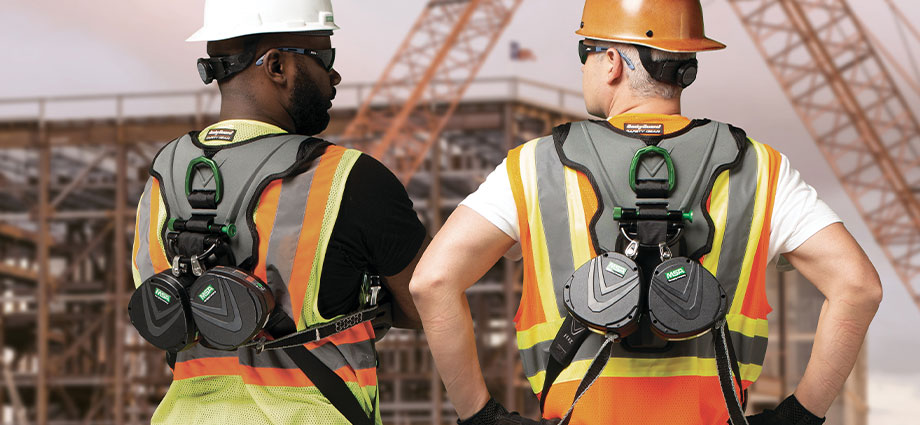
Fall Protection (29 CFR 1926.501) continues to rank at the top of the Occupational Safety and Health Administration’s (OSHA) most-cited construction standards, coming in as number one for the 14th year in a row in 2024.1
When it comes to fixed fall protection solutions, ladder cages on commercial and industrial facilities have been standard for decades, but evolving regulations from OSHA mean staying compliant may become more complex.
According to OSHA’s general industry rule (29 CFR 1910.28),2 fixed ladders over 24 feet must be equipped with certified fall protection systems—aligning with the construction standard (29 CFR 1926.1053) and ANSI A14.3 requirements. This went into effect on January 17, 2017, raising the threshold from the previous 20 feet to 24 feet and clarifying that any industry must guard ladders above that height with an approved system.
Why OSHA Phased Out Ladder Cages
By November 19, 2018, ladder cages were no longer considered an acceptable means of fall protection for new fixed ladder installations. While cages may still exist on ladders installed before that date, they are now only considered compliant under a “grandfather” clause, which expires on November 18, 2036.2
After this date, all fixed ladders above 24 feet must be equipped with either a Personal Fall Arrest System (PFAS) or an OSHA-compliant Ladder Safety System. Additionally, any repair or replacement of a ladder cage on existing ladders must include the installation of a compliant system—even if the original installation predated the 2018 regulation change.3
According to OSHA, key reasons for the transition are to incorporate “advances in technology, industry best practices, and national consensus standards to provide effective and cost-efficient worker protection.4
Components of a Personal Fall Arrest System
A Personal Fall Arrest System typically consists of an anchorage point, full-body harness, and connecting devices. In the case of fixed ladder applications, multiple solutions exist helping to allow the user to safely access and egress as well as ascend and descend a ladder. Integrated energy absorbing technology reduces the forces felt during a fall arrest, helping protect the employee as well as the ladder or structure the safety system is installed onto.
Benefits of a Personal Fall Arrest System include:
- Hands-free climbing: The lifeline device glides up or down a fixed cable or rail, letting both hands remain on rungs.
- Automatic engagement: Should a slip occur, the mechanism locks in milliseconds, limiting arresting forces.
- Adaptable fit: Harnesses are sized and adjusted to each worker, versus a one-size-fits-all cage dimension.
- Self-rescue capability: Many systems allow a worker to climb out of a fall arrest situation without assistance.
Components of a Ladder Safety System
A ladder safety system is “a system attached to a fixed ladder designed to eliminate or reduce the possibility of a worker falling off the ladder.”5 Key features include:
- Carrier or Track: Runs the full ladder height (and above landings), serving as the permanent anchor. It often is either a flexible cable or more rigid rail.
- Safety Sleeve: Piece that slides along the Carrier/Track and connects to a worker’s harness. If a fall occurs, this component locks onto the Carrier/Track, helping to arrest the fall.
- Lanyard: Connects the Safety Sleeve to a worker’s harness; this allows for movement up and down the ladder.
- Connectors: Hardware components that help join various pieces of the system together; for example, the Lanyard to the Safety Sleeve and Harness.
- Harness with Front D-Ring: Worn by the worker helping to evenly distribute the forces of a fall across the body and allowing for connection to the Lanyard.
Explore MSA Engineered Fall Protection Systems and Solutions.
Sources:
- https://www.osha.gov/top10citedstandards
- https://www.osha.gov/laws-regs/regulations/standardnumber/1910/1910.28
- https://www.osha.gov/laws-regs/standardinterpretations/2019-05-17
- https://www.osha.gov/walking-working-surfaces#:~:text=Benefits%20to%20Employers,with%20OSHA’s%20construction%20scaffold%20standards
- https://www.osha.gov/sites/default/files/publications/OSHA3903.pdf
Recommended for You