The A2L Shift is Real
A2L-classified refrigerants are poised to become some of the dominant cooling agents in the US market over the next several years. The change is driven, in part, by new regulations and a desire for more environmentally friendly refrigerants. With the shift gaining traction, modern refrigerant leak detector technology will become key to helping ensure adherence to monitoring requirements and to cost-saving efforts in systems using legacy refrigerant gases.
What is an A2L refrigerant?
“A2L” is a classification of refrigerant gases based on their flammability and toxicity. The American Society of Heating, Refrigerating, and Air-Conditioning Engineers (ASHRAE) outlines 8 different hazard classifications for refrigerant gases. The first letter is an expression of toxicity. The number is an expression of flammability, and an “L” at the end indicates a subcategory of lower speed at which the gas will burn. Figure 1, from a 2025 ASHRAE Factsheet titled “Update on New Refrigerants Designations and Safety Classifications,”1 explains those classifications.

Figure 1. ASHRAE refrigerant gas hazard classification
A2L refrigerants are at the lower end of both flammability and toxicity. The letter “A” indicates low toxicity, and the “2” indicates that the gas is flammable but less so than refrigerant gases with a designation of “3.” The “L” designation indicates that A2L refrigerants burn very slowly if ignited. Because of the slow-burning nature of the gases, a subcategory was added to indicate that the gas is flammable but poses a lower flammability risk.
Why are A2L refrigerants being used now?
This type of refrigerant gas is already prevalent in certain sectors. A 2022 article in the Building Safety Journal, a publication of the International Code Council, states that “more than 80 percent of new vehicles sold in the United States contain an A2L refrigerant.” 2But changes in regulations of refrigerant gases are driving the adoption in the HVAC industry, especially in the United States.
In 2020, the American Innovation and Manufacturing Act (AIM Act) was signed into law. This gave the Environmental Protection Agency (EPA) the authority to phase down the supply of hydrofluorocarbon (HFC) gases and transition toward refrigerants with a lower global warming potential (GWP). HFCs gained popularity as a replacement for chlorofluorocarbon (CFC) and hydrochlorofluorocarbon (HCFC) refrigerants after it was discovered that they are high ozone-depleting substances (ODS). They were replaced with HFCs, but research discovered that HFCs still have a high global warming potential (GWP). A2L refrigerant gases have been found to have substantially lower ozone-depleting and global warming potential, driving the switch to these gases.

Learn more about the AIM Act and what it means for the HVAC-R industry.
LEARN MORETransitioning To Lower Global Warming Potential Refrigerant Gases
What is global warming potential (GWP)?
The EPA explains that global warming potential is a unit of measurement intended to compare the overall global warming effects of different greenhouse gases.5 The unit of measure is derived by comparing the warming effect of a greenhouse gas with that of carbon dioxide (CO2). The measurement examines how much energy would be absorbed over a period of time by the release of 1 ton of any gas into the atmosphere, compared to 1 ton of CO2. The higher the number, the greater the warming effect the gas would have on the Earth compared to CO2 over the same time period.
Because carbon dioxide is the reference gas, it has a global warming potential of 1. According to the EPA, some gases can have GWPs in the thousands to tens of thousands. For hydrofluorocarbon (HFC) gas, the EPA lists a global warming potential of up to 12,400 over 100 years, with a potential atmospheric lifetime of up to 270 years.
The AIM Act is driving a change to more environmentally friendly refrigerants
Because of the climate risks posed by HFCs, the AIM Act empowers the EPA to restrict “the use of hydrofluorocarbons (HFCs) in sectors and subsectors where lower-global warming potential (GWP) technologies are available, or will be available in the near term.”3 An EPA fact sheet outlining the technology transition program states that regulations will require HFC production and consumption levels to fall to just 30% of historic baseline levels by 2029.4 This means that lower GWP refrigerant gases, like A2Ls and natural refrigerants, are expected to make up the dominant refrigerant gas mix in use for new equipment in the United States by the end of the decade.
To reduce potential leaks of HFC refrigerants, restrictions are now taking effect for certain types of refrigeration technologies. The restrictions limit the GWP levels permitted for particular applications and specify when the regulations take effect. The following chart outlines certain applications, GWP restrictions, and the effective dates:
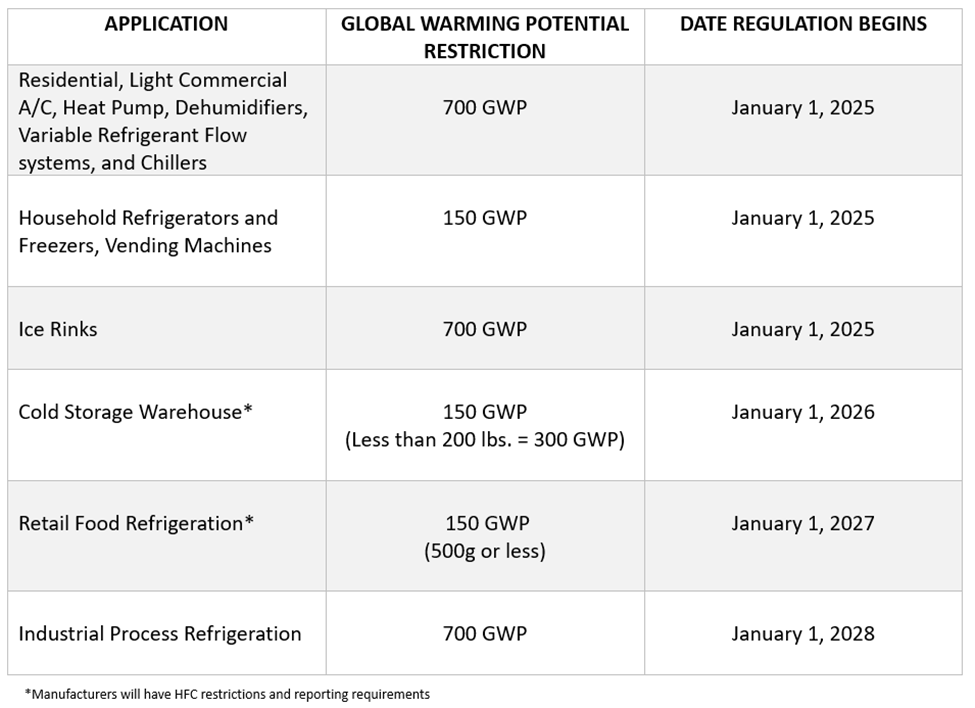
Figure 2 GWP restrictions as outlined in the EPA Technology Transition Program Fact Sheet 6
How are alternative refrigeration gases evaluated and selected?
The EPA’s Significant New Alternatives Policy (SNAP) program outlines how new refrigerant gases are evaluated and selected for use. There are seven variables analyzed when selecting alternative refrigerant gases for use, including:
- Ozone-depletion potential (ODP)
- Global warming potential (GWP)
- Flammability
- Toxicity
- Local air quality
- Ecosystem effects
- Occupational and consumer health and safety7
Substitutes are reviewed with the intent to reduce overall risks to human health and the environment. In 2024, the EPA released a Fact Sheet that outlines selected substitutes for commercial and industrial refrigeration as part of Final Rule 26. The ruling lists 10 refrigerants as acceptable, subject to use conditions.8
Why Do Many Applications Using A2l Refrigerants Require Refrigerant Leak Detectors?
As mentioned earlier, the name “A2L” is a description of toxicity and flammability hazards associated with refrigerant gases in that class. ASHRAE’s Standard 15 outlines “requirements to help protect people and property where refrigeration facilities are located.”1 In a June 2025 ASHRAE fact sheet titled “Update on New Refrigerants Designations and Safety Classifications,” ASHRAE states the following regarding potential safety hazards:
“Personal injury and property damage can result from a number of origins, such as rupture of a part with flying debris, release of refrigerant from a fracture or fire resulting from or intensified by burning, or deflagration of escaping refrigerant or lubricant. In addition, personal injury can result from the accidental release of refrigerants in inadequately ventilated spaces; narcotic and cardiac sensitization effects; toxic effects of vapor or the decomposition products due to vapor contact with flames or hot surfaces; corrosive attack on the eyes, skin, or other tissue; or freezing of tissue by contact with liquid.”1
Because of the potential hazards posed by an A2L refrigerant gas leak, refrigerant leak detection technology is necessary in many applications to help ensure the safety of people and property. In fact, in many applications, employing refrigerant leak detection technology is mandatory to comply with applicable regulations and standards.
Refrigerant Monitors Designed With Compliance In Mind
Versatility in Detection
Backed with a trusted legacy in refrigerant monitoring and leak detection, the MSA Bacharach® X30 and MSA Bacharach® X50 Refrigerant Monitors stand ready to help you meet the evolving needs of the refrigeration industry. The monitors are designed to readily detect A1, A2L, and natural refrigerants such as CO2. They also offer environmental versatility and can withstand temperatures of -40°F to 122°F (-40°C to 50°C). The monitors can detect refrigerant gas leaks with local, remote, or dual sensor options.
Ready for Today’s Compliance Needs
The X30 and X50 Refrigerant Monitors are designed to help you meet today’s compliance needs. The monitors are capable of helping support compliance with ASHRAE 15, CSA B52.2, EN 378, and F-Gas Regulation.
Simplified Commissioning & Bluetooth-capable
During the design phase, attention was given to ease of setup and commissioning, and the X30 and X50 monitors offer intuitive mounting, wiring, and configuration to simplify setup. The units are Bluetooth-capable, allowing users to connect via a mobile app to configure gas type and alarm settings and initiate test functions.
Future-Ready, Minimal Maintenance Design
The X30 and X50 Refrigerant Monitors are also future-ready, with the ability to effortlessly adapt to system upgrades via swappable, factory-pre-calibrated sensor modules. This helps save time and effort in the field.
MSA Bacharach® X30 Refrigerant Monitor
The MSA Bacharach X30 Refrigerant Monitor offers fast, intuitive installation and simple operation. It is a reliable refrigerant monitoring solution for cold storage, built with key features to simplify startup, use, maintenance, and compliance.
Key Features of the X30
- XGD Mobile App streamlines setup, configuration, and maintenance with an intuitive interface—no specialized tools or training required to define alarm parameters or thresholds
- Pre-calibrated sensors deliver measurable savings in time and operational costs by simplifying maintenance workflows
- Semi-automated calibration reduces the need for manual calibration — no potentiometers or voltmeters required
- Supports ASHRAE 15 and EN378 indication requirements
- Fast and straightforward wiring installation with daisy-chained power and digital communication
- Designed for all refrigeration environments—including machinery rooms, cold storage, and walk-in freezers — while maintaining reliable performance down to -40°F (-40°C)
The X30 features one configurable relay and supports Modbus communication protocols, enabling seamless integration with building management systems. For applications that need more relays or a remote gas sensor, check out the X50.
MSA Bacharach® X50 Refrigerant Monitor
The MSA Bacharach X50 Refrigerant Monitor helps you simplify refrigerant monitoring with a fast setup, smart app controls, and reliable remote sensor integration. Designed with intelligent features to meet the most demanding refrigeration safety standards, the X50 includes all the features of the X30, with additional capabilities to support more complex refrigerant monitoring needs.
Key Features of the X50
- Includes all features mentioned above for the X30 plus:
- 4 relay options with 1 being configurable
- Pairing with the MSA Bacharach® X10 Remote Gas Sensor, enabling you to monitor isolated, remote locations.
- Advanced dual-sensor capabilities for multi-gas detection or built-in redundancy
- Strobe alerting capabilities with integrated perimeter strobe
- Customizable entry options to accommodate your wiring, conduit, and cable gland needs
- Effortlessly connects to Building Management and Automation Systems via Modbus for seamless integration
The X30 and X50 represent simplified monitoring solutions, built for the modern refrigerant detection needs. Learn how the MSA Bacharach X30 and X50 Refrigerant Monitors can help you meet your compliance needs today!
REFERENCES
- https://www.ashrae.org/file%20library/professional%20development/ashrae-unep/unep—ashrae-factsheet–english.pdf
- https://www.iccsafe.org/building-safety-journal/bsj-technical/code-changes-on-a2l-refrigerants/
- https://www.epa.gov/climate-hfcs-reduction/frequent-questions-phasedown-hydrofluorocarbons#technology-transitions-program
- https://www.epa.gov/system/files/documents/2024-12/final_rule_fact_sheet_updated.pdf
- https://www.epa.gov/ghgemissions/understanding-global-warming-potentials
- https://www.epa.gov/system/files/documents/2024-12/final_rule_fact_sheet_updated.pdf
- https://www.epa.gov/mvac/acceptable-refrigerants-and-their-impacts
- https://www.epa.gov/system/files/documents/2024-05/snap-final-rule-26-factsheet.pdf
Recommended for You