• Skip to primary navigation
  • Skip to main content
  • Skip to footer
  • MARKETS & PRODUCTS
    • Markets


      Construction

      Cybersecurity

      Fixed Gas & Flame Detection

      General Industry

      Healthcare

      HVAC-R

      Oil & Gas

      Training

      Utilities

      Products


      Combustion Analysis

      Confined Space

      Connected Work

      Corporate

      Fall Protection

      Fixed Gas & Flame Detection

      Gas Analysis

      General

      Head Protection

      Heat Stress

      Leak Detection

      Portable Gas Detection

      Refrigerant Analysis

      Respiratory Protection

      Column
  • SUBSCRIBE

Safety in Confined Spaces: Important as All Get-Out

2 Min Read | Jul 15, 2019

Reading Time: 2 minutesThere is more to a confined space than what meets the eye. Therefore, safety should always be your number one concern. Read on to learn more about confined space safety.

July 15, 2019 by Kimberly Smith

Reading Time: 2 minutes
Confined Space Application

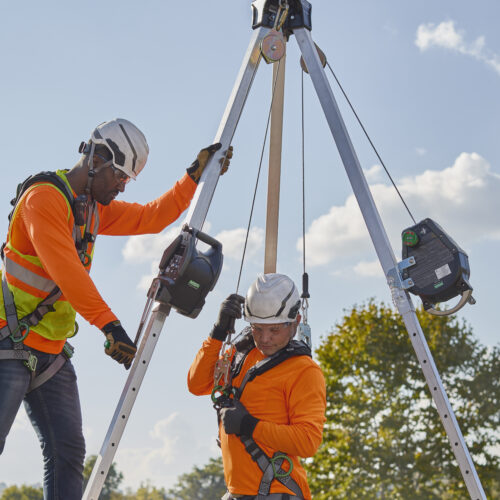
When most people hear the phrase enter a confined space, they think of wriggling into an attic crawl space or sliding behind the water heater in the basement. Uncomfortable and cramped, perhaps, but no big deal—or so they assume. Unfortunately, it’s easy to bring this casual attitude to the workplace, but industry professionals know that there’s much more to a confined space than meets the eye! Because many hazards—both seen and unseen—may await anyone working in a confined space, safety should always be the number one concern, especially on a job site. And that means understanding distinctions such as a non-permit work area (one with acceptable entry conditions) vs. a confined space vs. a permit-required confined space. To begin with, employers must identify all the confined spaces at every worksite. According to OSHA, to be considered a confined space an area must meet all of the following criteria, as follows:

OHSA 1910.146(b)
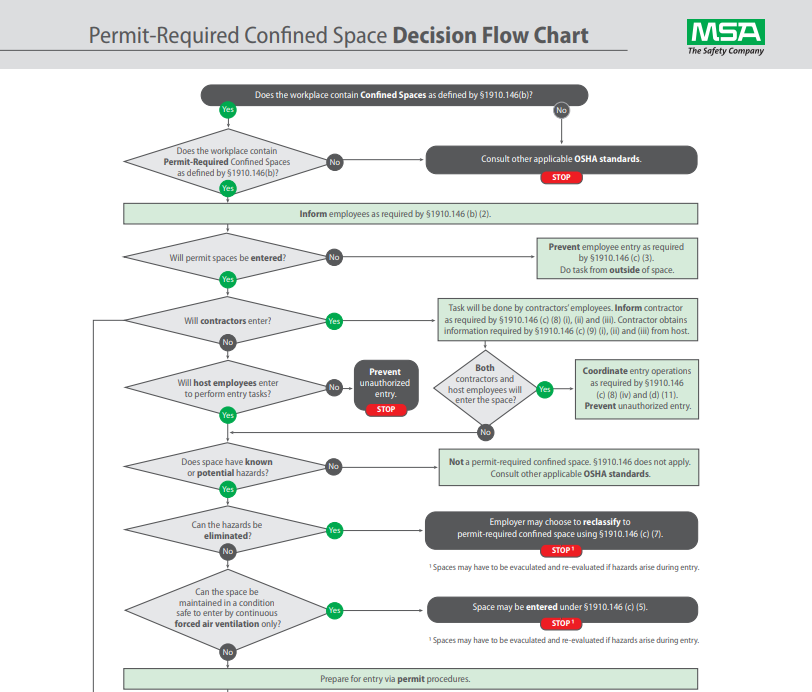
Confined Space Flow Chart
For help with your specific confined space situation, download our decision flow chart and share with your teams!

Download the Infographic

  1. Is large enough and so configured that an employee can bodily enter and perform assigned work.
  2. Has limited or restricted means for entry or exit (for example, tanks, vessels, silos, storage bins, hoppers, vaults, and pits are spaces that may have limited means of entry.)
  3. Is not designed for continuous employee occupancy.

Furthermore, an employer must evaluate each confined space with regard to (a) hazardous atmosphere; (b) engulfment; (c) entrapment or asphyxiation; and/or (d) other recognized serious safety or health hazards. If one or more of these indicators risk a worker’s health or safety, the area qualifies as a permit-required confined space. For help with your specific situation, click here for a decision flow chart. Once a permit-required confined space has been identified, OSHA 1910.146 and (Construction) OSHA 1926.1200 outline the required safety practices and procedures to be used in connection with tasks performed in the area. These regulations have been designed to leave as little as possible to chance so that emergencies can be avoided, or—if a crisis does occur—workers can either self-rescue or be rescued safely. This may sound straightforward, but working out the details of a permit-required confined space operation can be challenging. For instance, although sometimes overlooked, solid management support can mean the difference between success and failure. Additionally, factors such as controlling and/or eliminating hazards, documentation, and the team’s knowledge and skillset must be considered in order to enter, work in—and get out of—a confined space safely. Lastly, it’s important to note that this standard relates to OSHA’s 29 CFR 1910.146 for confined space in general industry.  Other confined space standards exist for additional industries and it’s important to consult the appropriate standards for your industry. We’ve included links to several confined space regulations as listed by OSHA OSHA Confined Space General Industry:

  1. https://www.osha.gov/SLTC/confinedspaces/standards.html

OSHA Confined Space Construction:

  1. https://www.osha.gov/confinedspaces/index.html
  2. https://www.osha.gov/confinedspaces/1926_subpart_aa.pdf

If you’d like a closer look at these key principles and more, click to watch the Ins and Outs of Confined Spaces online webinar.

Recommended for You

General Industry

Twelve Days of Safety: Navigating the Holidays with Joy and Caution

December 12, 2024
5 Min Read
Construction

Understanding the OSHA Proposed Rule on Heat Stress Prevention: “Heat Injury and Illness Prevention in Outdoor and Indoor Work Settings”

July 30, 2024
4 Min Read
Construction

Responding to Portable Gas Detector Alarms: Benefits of Connected Safety Solutions in Confined Space Applications

August 13, 2024
5 Min Read
Construction

Head Protection Quiz: Test Your Knowledge

August 28, 2024
< 1 Minute Read
Share:

Footer

MSA MISSION: That men and women may work in safety and that they, their families, and their communities may live in health throughout the world.

MSASafety.com

  • Construction
  • General Industry
  • Oil & Gas
  • HVAC-R
  • Utilities
  • Fixed Gas & Flame Detection
  • Fire Service
MSA on Facebook   MSA on X   MSA on Instagram   MSA on LinkedIn   MSA on YouTube  

Contact

  • blog@msasafety.com
  • 1-800-672-2222
  • View All Contact Info
  • Subscribe

Other MSA Blogs

  • Fire Service – The Scene
  • FieldServer – The Safety Connection

© 2024 MSA. All rights reserved.

© 2026 MSA . All rights reserved.

This website uses cookies to improve your experience. We'll assume you're ok with this, but you can opt-out if you wish. Accept Read More
Privacy & Cookies Policy

Privacy Overview

This website uses cookies to improve your experience while you navigate through the website. Out of these, the cookies that are categorized as necessary are stored on your browser as they are essential for the working of basic functionalities of the website. We also use third-party cookies that help us analyze and understand how you use this website. These cookies will be stored in your browser only with your consent. You also have the option to opt-out of these cookies. But opting out of some of these cookies may affect your browsing experience.
Necessary
Always Enabled
Necessary cookies are absolutely essential for the website to function properly. This category only includes cookies that ensures basic functionalities and security features of the website. These cookies do not store any personal information.
Functional
Functional cookies help to perform certain functionalities like sharing the content of the website on social media platforms, collect feedbacks, and other third-party features.
Performance
Performance cookies are used to understand and analyze the key performance indexes of the website which helps in delivering a better user experience for the visitors.
Analytics
Analytical cookies are used to understand how visitors interact with the website. These cookies help provide information on metrics the number of visitors, bounce rate, traffic source, etc.
Advertisement
Advertisement cookies are used to provide visitors with relevant ads and marketing campaigns. These cookies track visitors across websites and collect information to provide customized ads.
Others
Other uncategorized cookies are those that are being analyzed and have not been classified into a category as yet.
SAVE & ACCEPT