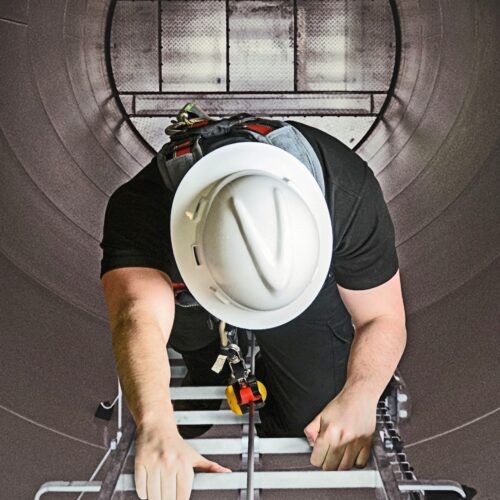
Confined spaces present health and safety risks for many workers. Which is why recognizing and planning appropriately for working in confined spaces so important.
A confined space can be defined as an area that:
- is large enough for an employee to physically enter and perform work
- has limited or restricted means of entry or exit
- is not designed for continuous human occupancy
- has the potential for significant hazards to be present
Prior to commencing work in confined spaces, employers must carefully identify and assess the hazards in order to determine which precautions to take. For full compliance with any applicable Federal and/or Provincial Regulations, such as the Occupational Safety and Health Administration (OSHA) standard governing confined spaces, 29 CFR 1910.146, it is necessary to rely upon the expertise of safety and health professionals such as industrial hygienists.
It is critical that procedures for confined space entry are followed before any worker enters such areas, especially where there is a reasonably foreseeable risk of serious injury in entering or working in the confined space.
What Fall Protection Equipment Is Needed For Confined Space?
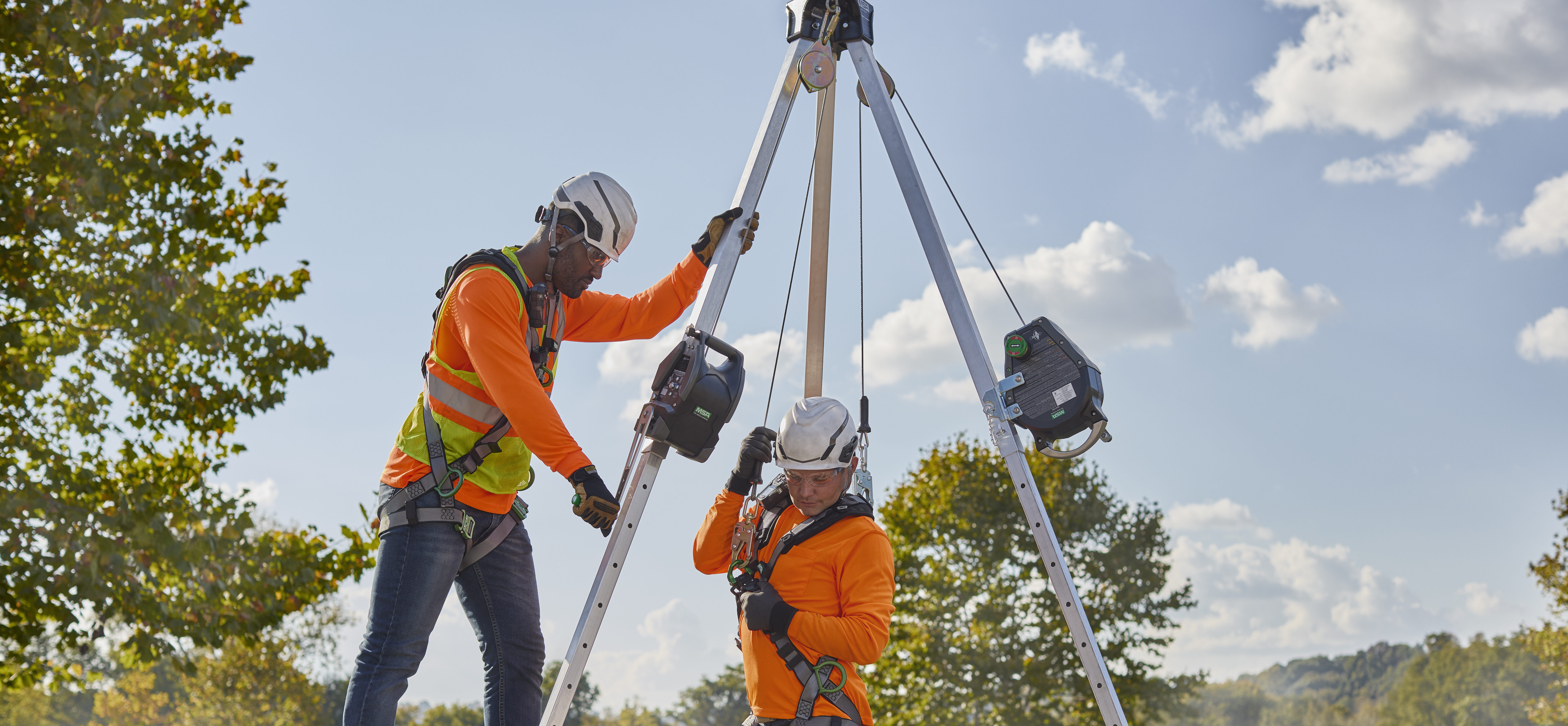
Confined space entry and retrieval equipment may be necessary to facilitate both entry into and exit from confined spaces. Proper retrieval systems for both workers and equipment consist of:
- full-body harness
- tripod or davit systems
- appropriate connecting devices
Retrieval equipment is useful in lowering workers into confined spaces as it controls descent rate and prevents accidental falls into the work area. Additional work hoists are frequently used to raise and lower tools and equipment. Every entrant should always wear a full-body harness and have some sort of lifeline attached to the harness – even in horizontal entry applications. If an entrant becomes non-responsive, the lifeline can be used to haul the worker out as a non-entry rescue.
If a worker must be quickly extracted from a confined space without entrance of another worker into that confined space (non-entry rescue), lifting equipment employs concepts of physics to raise entrants out of work areas. Hoists typically have a mechanical advantage of 25:1. It is very difficult for an average person to pull someone out of a deep manhole without some mechanical advantage.
Tripods and davit arms should be equipped with two mechanical devices for confined space entry: a hoist for raising and lowering materials and personnel, and a self-retracting lanyard (SRL) with emergency rescue capability for back-up fall protection and emergency retrieval. The SRL with emergency rescuer remains connected to the confined space entrant. The SRL feature allows the entrant free movement within the confined space and doesn’t require a topside attendant to constantly payout/retract the cable line on a hoist as the entrant moves around. If the entrant needs to be rescued, the top-side attendant activates the emergency rescue feature of the SRL and retrieves the entrant without entering the confined space.
A wide variety of approved harnesses are available for use with retrieval equipment. Shoulder, back, or chest D-rings/loops may be used as retrieval line attachment points. For confined space emergencies with extremely tight openings, a spreader bar is an ideal solution providing both comfort and security when lowering and lifting workers.
Proper Inspection and Training
Before entry into confined space work areas, all equipment should be inspected carefully before each use. Any equipment that shows any signs of wear, damage or doesn’t pass the inspection should not be used. Due to various risks and the number of different equipment that can be used, all personnel involved in confined space entry, including supervisors, entrants, attendants, and rescue personnel, should be well trained. Individuals authorizing confined space entry must have complete knowledge of the space’s contents and hazards. All confined space workers must fully understand their duties prior to entry or if there are changes in assigned duties or confined space applications.
Confined Space Quiz
Think you know everything about confined space entry and exit? Test your confined space I.Q. with this quiz.
Take QuizRecommended for You