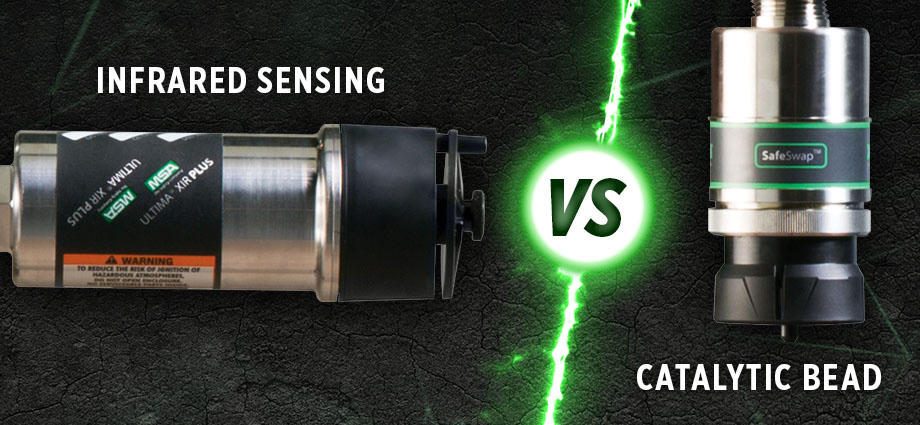
Infrared (IR) and catalytic bead gas detectors are both commonly used to monitor combustible gas hazards in industrial environments. The most appropriate technology depends on factors such as the gases being monitored, environmental conditions, maintenance requirements, and operational objectives.
In general:
- Infrared gas detectors are commonly selected for hydrocarbon monitoring where resistance to catalyst poisoning is an important consideration.
- Catalytic bead gas detectors are often used when facilities require broad combustible gas detection, including gases such as hydrogen that conventional IR technology cannot detect.
- Many facilities use a combination of both technologies to address different risk scenarios.
What Is a Catalytic Bead Gas Sensor?
A catalytic bead gas sensor measures combustible gases through a controlled oxidation process. When combustible gas contacts the catalyst surface, additional heat is generated. The resulting temperature change is converted into an electrical signal that correlates with gas concentration.

As illustrated above, a wire coil is coated with a catalyst-coated glass or ceramic material (active bead) and is electrically heated to a temperature that allows it to burn (catalyze) the gas being monitored, releasing heat and increasing the temperature of the wire in proportion to the concentration of the gas. As the temperature of the wire increases, so does its electrical resistance. This resistance is measured by a Wheatstone Bridge circuit and the resulting measurement is converted to an electrical signal used by gas detectors. A second sensor, the reference bead, is used to compensate for temperature, pressure, and humidity.
Catalytic bead technology has been used across industrial safety applications for decades and remains widely deployed in:
- Oil and gas facilities
- Refineries
- Chemical plants
- Utilities
- Manufacturing operations
Advantages of Catalytic Bead Gas Detectors
Potential benefits may include:
- Broad combustible gas detection capability
- Detection of hydrogen and other gases that are not IR active
- Familiar operating principles for many safety teams
- Field-serviceable sensor designs in certain models
- Lower initial acquisition costs in some applications
Limitations of Catalytic Bead Gas Detectors
Organizations should also evaluate potential constraints:
- Sensor performance may be affected by poisoning from silicones or hydrogen sulfide (H2S).
- Oxygen is required for the sensing process.
- Routine bump testing and calibration verification are generally recommended.
- Extended exposure to high gas concentrations at or above the lower explosive limit (LEL) may affect sensor performance over time.
What Is an Infrared Gas Detector?
Infrared gas detectors identify gases by measuring how specific wavelengths of infrared light are absorbed as gas passes through the optical path.
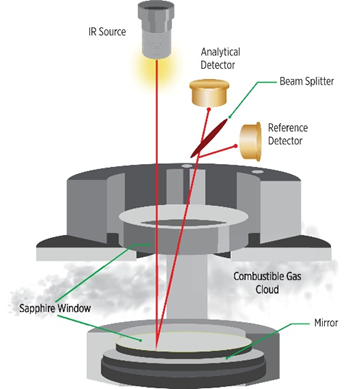
Non-dispersive infrared (NDIR) technology uses a gas’s ability to absorb IR radiation. Infrared light is directed through the gas being monitored and measured at two wavelengths – one absorbed by the gas of interest (if/when present), and a reference wavelength that is not. The amount of light reaching each detector is compared to determine the concentration of the gas of interest. Each detector is sensitive to a different range of wavelengths in the infrared portion of the spectrum. The source emission is directed through a window in the main enclosure into an open volume. A mirror may be used at the end of this volume to direct the energy back through the window and onto the detectors.
The presence of a combustible gas will reduce the intensity of the source emission reaching the analytical detector, but not the intensity of emission reaching the reference detector. The microprocessor monitors the ratio of these two signals and correlates this to a % LEL reading. Because the technology is based on light absorption rather than oxidation, infrared detectors do not rely on oxygen to function.
Infrared detection is available in:
Advantages of Infrared Gas Detectors
Potential benefits may include:
- Resistance to poisoning
- Operation in oxygen-deficient or oxygen-enriched environments
- Reduced calibration frequency in some applications
- Capability to detect hydrocarbon gas clouds over larger areas when used in open-path configurations
- Continuous operation in the presence of target gases
Limitations of Infrared Gas Detectors
Considerations may include:
- Target gases must be infrared-active.
- Hydrogen generally cannot be detected with conventional IR technology.
- Optical surfaces may require cleaning in dusty, humid, or corrosive environments.
- Factory service may be required for certain repairs depending on design.
- Initial purchase costs may be higher than catalytic bead alternatives.
Infrared vs. Catalytic Bead Gas Detectors: Side-by-Side Comparison
| Feature | Catalytic Bead | Infrared (IR) |
| Detection Method | Measures heat generated by catalytic oxidation of combustible gas | Measures absorption of infrared light by gas molecules |
| Detects Hydrocarbon Gases | Yes | Yes |
| Detects Hydrogen | Yes | No |
| Requires Oxygen | Yes | No |
| Susceptible to Poisoning | May be affected by poisoning from silicones or hydrogen sulfide | Not generally susceptible to catalyst poisoning |
| Works in Oxygen-Deficient Environments | May be limited depending on oxygen supply | Yes |
| Continuous Gas Exposure | Performance may be affected over time in some applications | Designed to operate in continuous gas presence |
| Calibration Requirements | Periodic calibration verification recommended | May require less frequent calibration depending on site procedures |
| Maintenance Focus | Sensor performance verification and calibration checks | Optical inspection and cleaning |
| Open-Path Monitoring Available | No | Yes |
| Field Sensor Replacement | Often available depending on model | Varies by manufacturer and design |
| Initial Equipment Cost | Often lower | Often higher |
| Typical Use Cases | Hydrogen monitoring, multi-gas applications, general combustible gas detection | Hydrocarbon monitoring, oxygen-deficient environments, open-path coverage |
When Should You Choose Each Technology?
| If You Need To… | Consider |
| Detect hydrogen | Catalytic bead |
| Monitor hydrocarbon gases | Infrared or catalytic bead |
| Operate without oxygen present | Infrared |
| Reduce risk of catalyst poisoning | Infrared |
| Deploy open-path gas detection | Infrared |
| Minimize upfront equipment costs | Catalytic bead |
| Detect multiple combustible gases | Catalytic bead may be appropriate |
| Monitor large outdoor areas | Infrared open-path systems |
Why Many Facilities Use Both Technologies
A common misconception is that facilities must choose one gas detection technology exclusively.
In reality, many industrial gas detection programs deploy both technologies to address different hazards and operating conditions. For example:
- Catalytic bead detectors may be used in hydrogen process areas.
- Infrared detectors may be used in hydrocarbon processing zones.
- Open-path IR systems may supplement point detectors where large gas clouds could develop.
- Different technologies may be deployed according to a site’s hazard analysis and risk mitigation strategy.
Frequently Asked Questions
Neither technology is universally better. The appropriate choice depends on the gases being monitored, environmental conditions, maintenance capabilities, and application requirements.
No, hydrocarbon infrared detectors cannot detect hydrogen because hydrogen is not infrared-active and does not absorb infrared energy the way hydrocarbons do.
Yes. Catalytic bead sensors rely on oxidation and therefore require oxygen to perform their sensing function; infrared sensors do not.
Calibration practices vary by manufacturer and site procedures. While some IR detectors may require less frequent calibration, periodic functional testing is commonly recommended as part of a comprehensive maintenance program.
Yes. Many facilities use both technologies within the same gas detection system to address different hazards and operating requirements.
Key Takeaway
The question is not whether infrared or catalytic bead gas detection is inherently superior. The more important question is which technology best aligns with the hazards, environmental conditions, maintenance strategy, and performance requirements of your specific facility.
A site-specific risk assessment can help safety professionals determine whether catalytic bead detectors, infrared detectors, or a combination of both technologies are appropriate for their combustible gas monitoring strategy.
Find the Right Combustible Gas Detector for Your Application
Whether you’re evaluating infrared detectors, catalytic bead sensors, or a layered detection approach, our team can help you identify a solution tailored to your operational needs.
Explore our gas detection solutions or contact an expert today.
Recommended for You