Liquefied natural gas (LNG) continues to play a growing role in the world’s energy mix, offering a cleaner-burning fuel alternative for power generation, shipping, and industrial use. As LNG moves through an increasingly complex global supply chain—from carriers at sea to storage terminals and regasification plants onshore—one thing remains constant: safety is a top priority.
While LNG is non-toxic, its hazards are real. LNG is primarily methane in liquefied form. While the goal is to achieve as pure a composition as possible, small amounts of other hydrocarbons or impurities may still be present. When a spill occurs, the liquid is extremely cold and often visible as a white vapor cloud due to rapid condensation of moisture in the air. As it warms and vaporizes, the gas becomes invisible—making reliable detection essential.
That’s why gas and flame detection systems are an important safeguard across the LNG supply chain, providing early warning and helping operators respond before a leak becomes a larger incident.
From the Open Sea to Dockside Safety
LNG carriers are engineered with multiple layers of protection to reduce risk. Design features such as double hulls, ballast tanks separated from cargo tanks, and thick insulation provide structural barriers against leaks. The two common cargo tank designs—membrane tanks and spherical tanks—each hold liquid LNG with a vapor space above, and both present specific points that require continuous monitoring.
To address these risks, carriers are equipped with comprehensive safety systems. Gas detectors are strategically placed wherever gas could collect, including compressor rooms, control rooms, and enclosed spaces where air circulation may be limited. Potential leak spaces, such as the insulation area around cargo tanks, are given special attention. On membrane ships, these insulation spaces are filled with nitrogen (an inert gas) and continuously monitored with point detectors to identify any trace of methane.
Flame detectors add another layer of protection, designed to provide rapid response if a leak were to ignite. Together, these detection systems help provide crews with early warning so corrective actions can be taken quickly.
When LNG moves from ship to shore, detection technology continues to support safe operations. During transfer activities, detectors monitor loading arms, manifolds, and vapor recovery systems for leaks. Open-path detection technology is often deployed across dockside areas to provide long-range monitoring, especially where point sensors alone may not be sufficient.
Safeguarding LNG at Terminals and Regasification Plants
Once LNG is stored in tanks or processed at regasification facilities, the risks shift but don’t disappear. Continuous monitoring in vaporizers, high-pressure pumps, and pipelines helps identify leaks early. Strategic placement of detectors in processing areas and equipment rooms reduces the chance of methane accumulation, while integration with emergency shutdown (ESD) systems provides an added layer of protection.
At large facilities, detection zones are typically configured with voting logic, meaning that alarms from more than one detector are usually required before automatic actions—such as isolation, ventilation, or system shutdown—are initiated. This approach helps reduce the chance of false trips while still providing a strong safety response when a genuine leak is detected. Layered protection strategies like these are intended to help minimize the impact of an incident while supporting operational continuity.
Terminals also face unique challenges with open, outdoor environments. Wind, weather, and large physical structures can influence gas dispersion. Gas mapping during the design phase can help determine the most effective detector placement, ensuring reliable coverage across complex layouts.
Detection Designed for LNG Environments
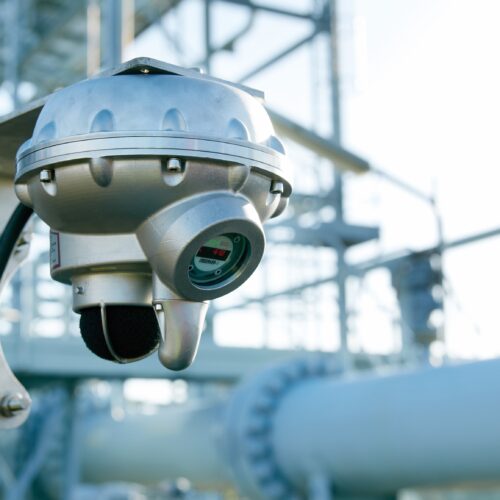
Detectors vary in design and performance. LNG operations benefit from devices that can withstand extreme temperatures, marine conditions, and challenging light environments. Infrared and catalytic detection technologies can work together to provide broad coverage, and multi-spectrum flame detectors are designed to help reduce false alarms caused by sunlight or reflective surfaces.
Beyond performance, ease of maintenance is equally important. Remote monitoring and notification through cloud connectivity and Bluetooth® communication (with appropriate safety approvals) are increasingly used to access the information from detectors remotely, reducing the need for personnel to enter hazardous zones. Extended-life sensors and self-calibration features can help reduce maintenance requirements and may lower total cost of ownership over time.
A Continuous Safety Net
From the moment LNG leaves a carrier until it is safely delivered as gas into the energy grid, gas and flame detection systems provide a critical role in the first layer of defense. Networked systems that share real-time data can connect shipboard safety with shore-based monitoring, supporting more consistent coverage across the supply chain. Remote monitoring and predictive diagnostics also help operators maintain readiness while reducing maintenance downtime.
Looking ahead, digital integration is becoming just as important as physical safety hardware. Advanced detectors can feed directly into distributed control systems (DCS), safety instrumented systems (SIS), and cloud platforms—supporting operators in responding to hazards, analyzing trends, assessing risks, and planning proactive maintenance.
Keeping LNG safe requires vigilance at every stage, and gas and flame detection supports that safety culture—from ship to shore and everywhere in between.
Learn more about advanced detection solutions for LNG operations at MSA LNG Detection.

Maintaining Safety of LNG Facilities
Download White PaperRecommended for You