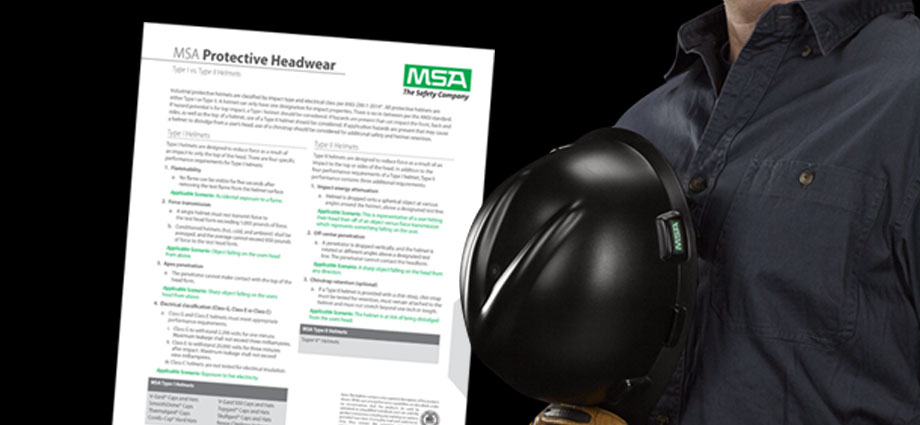
Type I vs. Type II head protection has become a hot topic across industries, driven by recent OSHA recommendations and innovative new product developments.
But how can you determine which solution is right for your jobsite and application? Choosing proper head protection often requires taking several key factors into consideration, especially the hazards and risks that are specific to your jobsite and application. These can be determined by conducting a hazard assessment. In fact, a hazard assessment may be a required step before choosing PPE under applicable regulations, including OSHA.
Here are five key steps you may want to include in your hazard assessment to help determine the appropriate Type I and Type II head protection solutions for your application.
1. Understand the Application and Potential Hazards
The first is to fully understand the work environment and the specific risks workers may encounter. Ask questions such as:
- Is the work being done at height or in confined space?
- Are there nearby electrical hazards?
- Will workers be exposed to extreme temperatures or weather conditions?
- Is there potential for chemical splashes or welding sparks?
- What are the risks of falling objects or lateral impacts?
This foundational knowledge sets the stage for the decisions that follow.
2. Determine Electrical Classification and Style
Based on the hazards identified, the next step is to determine the appropriate electrical classification and style of head protection:
- Electrical Classification: Head Protection options fall within the below classes based on protection from electrical hazards:
- Class C (Conductive – no electrical protection),
- Class G (General – up to 2,200 volts), or
- Class E (Electrical – up to 20,000 volts).
Remember that if workers require protection from electrical hazards, a non-vented hard hat or helmet is needed.
- Helmet Style: Think about the work setting, along with worker preference in terms of look and style. Consider questions such as:
- Do workers require brimless helmets for climbing or confined spaces?
- Or is a full brim more beneficial for sun protection during outdoor work?
3. Comply with Industry Standards and Requirements
Identify which standards apply for impact resistance and direction based on your region and industry. Safety helmets and hard hats fall under either Type I or Type II based on ANSI and CSA standards:
- ANSI/ISEA Z89.1 (U.S.) and CSA Z94.1 (Canada):
- Type I: Designed to reduce force as a result of an impact to ONLY the top of the head.
- Type II: Designed to reduce force as a result of an impact to the front, back, sides, and top of the head.
- EN12492 (Europe): EN12492 may be relevant in climbing or technical rescue scenarios. Helmets certified to EN12492 (mountaineering/climbing standard) feature a slightly expanded top impact protection zone compared to traditional helmets. While EN12492-certified helmets offer additional top impact protection compared to ANSI Type I industrial hard hats, they are not equivalent to ANSI Type II helmets, which are specifically designed to provide lateral (side) impact protection. Therefore, EN12492 does not meet the same side-impact criteria required under ANSI Type II standards.
Before choosing a hard hat, check to be sure that it meets the appropriate protection requirements for the application. If lateral protection is required, choose a helmet certified as Type II.
4. Consider Additional Head, Eye, Face, and Hearing Protection Accessories
Depending on the work environment and application, workers may require accessories. Ask questions such as:
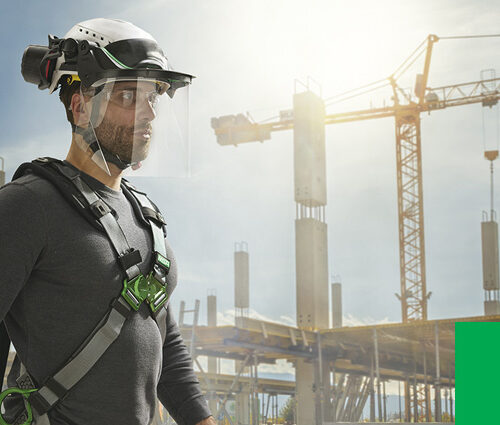
- Does the worker require face protection from impact, glare, UV exposure, or other hazards, such as radiant heat, arc flash, and splash? Options such as visors can accommodate these types of applications.
- What specific eye protection is needed? Consider options for eyewear including anti-fog/anti-scratch, integrated spectacles, and over-spectacles for those wearing prescription eyewear.
- Is the worker in a high-noise environment where hearing protection is needed? Helmet mounted muffs are available for both cap and hat styles of hard hats.
Additional accessory considerations include goggle retainers or even cooling pads if heat stress is a concern.
One important note is to check whether each accessory has been tested and approved for use on the helmet that has been selected. Many manufacturers will recommend that you use only approved accessories on their hard hats to ensure that they have been tested to work as a system and the installation of that accessory will not impact the performance of the hard hat and vice versa.
5. Evaluate Additional Considerations
Finally, look beyond the obvious hazards. Additional factors can influence your choice of head protection:
- Heat stress: Is the work environment outdoors in sunny conditions? Ventilation and lightweight materials may be key. Recent innovations, such as the patent ReflectIR™ thermal barrier in the V-Gard C1® Hard Hat, are specifically designed to help reduce worker heat stress in outdoor settings.
- Rotational impact protection: Advanced systems, particularly the Mips® brain protection system for industrial safety helmets, can provide enhanced protection in the event of angled impacts to help reduce the risk of traumatic brain injury. Two new Type II solutions – V-Gard H2® Safety Helmet and V-Gard H2® Full Brim – can be purchased with the optional addition of the Mips® system.
- Third-Party Certification: With third-party certification, a separate organization verifies that the hard hat or safety helmet meets the ANSI certification called out on the product’s approval label, and conducts testing through accredited laboratories to help ensure standardized and consistent results across head protection solutions from various manufacturers. The certification organization also inspects the manufacturing facility to make sure it meets quality standards. All MSA Type I and Type II hard hat and safety helmet solutions are third-party certified through the Safety Equipment Institute (SEI).
- Worker comfort and compliance: If a helmet is uncomfortable, workers are less likely to wear it properly. Comfort and fit can be just as critical as protection.
- Customization with Logos and Stripes: Many manufacturers, including MSA, offer customization options which can range from a logo to personalization including a name, project or title. Personalizing the hard hat may help motivate the worker to wear it, since it is a more customized and stylish version. MSA’s customization process provides flexibility, speed, and accuracy without sacrificing logo quality and durability.
Choosing Industrial Head Protection Options
Conducting a thorough hazard assessment is a proactive step in determining the appropriate Type I and Type II head protection solution for workers across industrial jobsites and applications. For additional guidance, materials developed by OSHA’s Directorate of Training and Education are intended to “assist employers, workers, and others as they strive to improve workplace health and safety.” Visit OSHA’S Personal Protective Equipment (PPE) Assessment for more detailed information on conducting a hazard assessment and selecting PPE.
This article is for general educational purposes only, and is not legal or regulatory advice. Your worksite or application may have additional or different considerations or obligations under applicable regulations.
Established in 1914, MSA Safety is the leader in head protection experience dating back to the 1930s with one of its first products: the iconic Skullgard®. Today, MSA Safety has more than 10 head protection lines in Northern North America, covering a comprehensive selection of Type I and Type II head protection. MSA safety experts can help in selecting head protection and guiding you through the steps of a hazard assessment of your own jobsite.
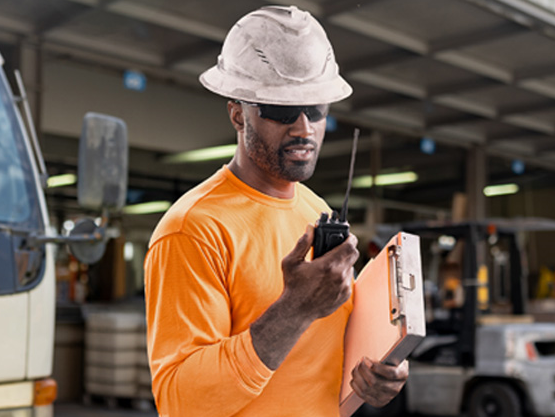
Type I and Type II Solutions from MSA, the Leader in Head Protection
Explore MSA head protection solutions and request more information from an expert.
LEARN MORERecommended for You