Cooling systems are under growing pressure as data centers accommodate more powerful equipment and higher-density workloads. With greater heat being generated within a smaller footprint, even a relatively small reduction in cooling performance can become an operational concern much more quickly than it might have in a traditional data center environment.
Refrigerant leaks are not always sudden or immediately obvious. A small leak may develop gradually around a joint, valve, seal or another component, allowing the refrigerant charge to fall over time. During the early stages, the system may continue to maintain its required temperature, giving little outward indication that performance has started to change.
However, as refrigerant levels continue to drop, the effects can be felt across efficiency, increased system wear and cooling capacity.
1. Cooling efficiency can begin to drift
A cooling system is designed to operate with the correct refrigerant charge. When refrigerant is lost, the system may need to work harder or run for longer to maintain the required temperature.
Compressors may operate for extended periods, while control systems adjust to compensate for the reduction in performance. Set points may still be maintained, but more energy and equipment runtime may be required to achieve them.
This gradual change can be described as efficiency drift. Because cooling output does not necessarily disappear immediately, the underlying problem may remain unnoticed while energy use increases and system performance moves away from its intended operating conditions.
Identifying a developing leak earlier gives engineering and maintenance teams more time to investigate the cause before the loss of refrigerant begins to have a more significant effect on cooling efficiency.
2. Additional workload can place strain on components
The impact of a refrigerant leak is not limited to energy performance. As cooling equipment works harder to compensate for a declining refrigerant charge, additional strain may also be placed on compressors, motors and other key components.
Longer operating cycles can increase equipment workload, while continued operation outside the system’s intended conditions may contribute to component wear. Over time, this can affect reliability and increase the likelihood of maintenance being required.
The challenge is that this strain may develop before a Refrigerant Monitor’s alarm is triggered. From the outside, the equipment can appear to be working normally because temperatures remain within the expected range. In reality, the cooling system may already be compensating for a loss of charge.
Earlier visibility allows teams to investigate while the equipment is still operating, creating more opportunity for planned maintenance rather than waiting for a fault, pressure trip or loss of capacity.
3. Reduced cooling capacity can increase shutdown risk
As refrigerant loss continues, the system may eventually be unable to provide the cooling capacity needed to meet the facility’s thermal load.
This is particularly important in high-density environments, where equipment generates significant heat and there may be less time available to respond to a reduction in cooling performance. A low-pressure trip or unexpected cooling-system shutdown could cause temperatures to rise quickly, placing hardware availability, uptime and service-level commitments at risk.
What begins as a small and difficult-to-see leak can therefore develop into a much wider operational issue. By the time a critical alarm is activated, the opportunity for a controlled response may already have narrowed considerably.
Detecting refrigerant at lower concentrations can provide an earlier indication that conditions are changing. This does not remove the need for appropriate system controls or maintenance procedures, but it can give teams valuable additional time to locate the source of a leak, assess its development and plan an appropriate response.
Creating earlier visibility with aspirated leak detection

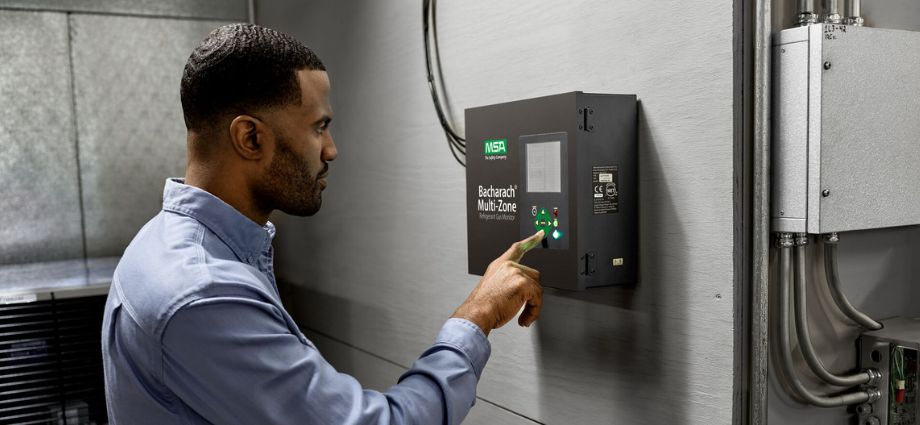
The Bacharach® Multi-Zone gas monitor from MSA Safety uses aspirated sampling to draw air from multiple monitoring points back to a central infrared sensor for analysis. Sampling points can be positioned near chillers, compressors, valves and other areas where leaks may develop.
The monitor can detect supported refrigerants at concentrations as low as 1 ppm and sequentially sample up to 16 zones. This helps provide zone-specific visibility across complex cooling infrastructure and can support the identification of low-level refrigerant presence before it develops into a more significant loss of charge.
By identifying changes earlier, data center teams can gain more time to investigate emerging issues while cooling equipment is still operating – helping them take a more proactive approach to protecting system efficiency, equipment reliability and uptime. Explore how the Bacharach Multi-Zone gas monitor can support earlier refrigerant leak detection across critical data center cooling infrastructure. Contact MSA Safety to discuss your application with a refrigerant-detection specialist.
Recommended for You